BEIJING - China's new accounting regime, shifting focus from GDP to a more balanced development outlook, signals the end of the era of "GDP supremacy".
The regime, announced earlier this month by the National Bureau of Statistics (NBS), is a multi-faceted assessment of the economy that equally weighs structural optimization, industrial upgrades, innovation, the environment, improvements to people's livelihoods, etc.
To assess these fields, over 40 economic indicators--consumption, urbanization, debt-to-fiscal revenue ratio, research and development spending, pollution--will be regularly published by statistical authorities.
The NBS believes that government statistics used to overemphasize GDP and the new standards will be a better reflection of the quality and benefits of economic development.
Double-digit growth may have propelled China to become the world's second-largest economy, but to a large extent it was pursued by government officials simply because it determined their promotions, and had many undesirable consequences: industrial overcapacity, environmental damage, uneven development.
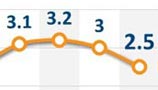
With a slowing economy aiming for 7.5 percent growth this year, the government has concentrated on reform, restructuring and improving people's livelihoods. The government will not be distracted by minor fluctuations of individual indicators, Premier Li Keqiang said during Summer Davos in Tianjin this month.
Li declared the key agenda to be structural control, with coordination between stabilizing growth, promoting reform, readjusting structure, improving people's livelihoods and preventing risks. Industrial upgrading and reducing the gap between rural-urban development are to be promoted through science and technology innovation. He promised to reduce pollution and conserve energy.
Targets on greenhouse gas emissions including peak CO2 emission, carbon emission intensity and increasing the share of non-fossil energy by 2030 and beyond are at the front of government thinking. Carbon intensity actually dropped by about 5 percent in the first half of the year, the largest drop in many years, and energy consumption per unit of GDP also dropped 4.2 percent.
At least 70 counties have adopted people's livelihoods and environmental protection as the major criteria for assessing officials' performance instead of GDP growth.
"In the long term, economic restructuring is a necessity for China; in the short term, such a restructuring is urgent especially after the impact of the global financial crisis," said Xie Lujiang, professor at the Party School of the Central Committee of the Communist Party of China.
Xie said that the fundamental purpose of restructuring is to build a modern country in the truest sense, with changes on many fronts, including politics, economics, institutions, and vested interests.
The NBS timetable for introducing the new accounting regime shows some indicators being released this year.
Premier Li has also called for a dialectical view of economic growth because China, a developing country, still needs a certain level of growth, but the growth must create jobs, raise people's incomes, help protect the environment and save energy. GDP supremacy is no more.

Copyright 1995 - . All rights reserved. The content (including but not limited to text, photo, multimedia information, etc) published in this site belongs to China Daily Information Co (CDIC). Without written authorization from CDIC, such content shall not be republished or used in any form. Note: Browsers with 1024*768 or higher resolution are suggested for this site.
License for publishing multimedia online 0108263 Registration Number: 20100000002731