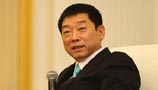
"If you told a company you were going at 2:30 pm tomorrow afternoon they might try and hide evidence of any antitrust behavior. What has happened in China recently is normal practice everywhere," she says.
Wang was born in Zhangjiakou in Hebei province but was brought up in Inner Mongolia autonomous region. Her father worked for the local government and her mother was an auditor.
Just before she was about to graduate from high school, she was caught up in the "cultural revolution" (1966-76) and was sent to the countryside to work on a farm.
"I didn't complain. There were about 20 students like me all living, working and eating together. The farmers were very friendly toward us, although it was a very hard life."
Later, after working in a brick factory in the region's capital Hohhot, she was one of the first generation to go back to university, beginning a philosophy degree at Inner Mongolia Normal University at 30, when by then she already had two boys.
Her husband had studied law at the same university and she studied for law examinations soon after graduating before going to do a master's degree in law at Renmin University of China in Beijing.
It was a move to Germany in the late 1980s that led to her specializing in competition law when she did a doctorate at the University of Hamburg under the supervision of Ernst-Joachim Mestmacker, one of Europe's leading authorities in antitrust law. She was there for six years and has since produced books and papers in German.
"Going to study in Germany was a key step in my life. It enabled me to understand the legal systems of developed market economies. It also allowed me to pioneer the study and research of anti-monopoly law in Chinese academic circles."
As a result she was the only legal academic involved in drafting China's anti-monopoly laws when the process began in 1994, although others subsequently become involved too.
"Competition law was vital for the transformation of the Chinese economy. When it was a planned economy, everyone and everything belonged to the government so these issues weren't relevant.
"Without laws, companies would just collude. It is far easier for a television manufacturer to agree the price of a television with a rival manufacturer than to compete with it but it would be against the interest of the consumer. It was therefore essential for China to have monopoly legislation in place."
Wang says the rise of China will be a game changer for how monopolies are policed globally.
In the EU, companies are often fined up to 10 percent of their global turnover for infringements.
In China the fines imposed tend to be only on domestic turnover or on the sales of a particular product line. The National Development and Reform Commission, one of China's main anti-monopoly regulators, fined 10 Japanese car part manufacturers, including Sumitomo Electric, 6 percent of their China revenue on Aug 20.
"You can't have a situation where a company is fined up to 10 percent of global revenues in every jurisdiction since there is only so much of their global turnover to go round," she says.
"I think the emergence of a large market like China will change how monopolies are controlled and other jurisdictions will begin to impose fines on revenue within their own areas."
 |
 |
|
|
Top 9 anti-trust cases in China |

Copyright 1995 - . All rights reserved. The content (including but not limited to text, photo, multimedia information, etc) published in this site belongs to China Daily Information Co (CDIC). Without written authorization from CDIC, such content shall not be republished or used in any form. Note: Browsers with 1024*768 or higher resolution are suggested for this site.
License for publishing multimedia online 0108263 Registration Number: 20100000002731