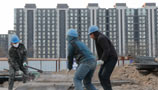
XIAOGANG - Xiaogang village in East China's Anhui province, once one of China's poorest village four decades ago, has seen "rural urbanization" unleash economic vitality and allow its residents to stay close to home.
"Sweet" local jobs
Han Hongxiu has worked for Fengyang Golden Xiaogang Agri-Forestry Scientific and Technological Industry Ltd Co for two years. This is "the perfect" job for him, as the company is only a 10 minutes walk from his house. So, he can enjoy dinner with his wife every day and still continue to work his 7 mu (0.47 hectare) plot of rice paddy.
Xiaogang, like many other villages across the country, has initiated agricultural reform that allows families to transfer part of their farming land to companies in return for a fee, and this is reinvigorating farmers' lives.
Fengyang Golden pays Han's family 800 yuan ($128.77) each year for every mu of transferred land. Han transferred 17 mu (11.4 hectares) of land to the company and kept the remaining 7 mu for his family. In addition, farmers in Xiaogang that have leased their land to the company are given employment preference.
Han, 52, still remembers vividly his hand-to-mouth existence prior to 1978, the year the village initiated the landmark reform measure, and is more than satisfied with his 2,400 yuan monthly salary for tending to blueberry and cherry seedlings.
The growing Chinese middle class has a huge appetite for exotic fruits such as these, and the climate and soil conditions drew the Shandong-based company to Xiaogang.
The fact that Han's wife also works at the same company also has many benefits, as previously he had to work away from home and live alone in southern China, often only meeting his wife twice a year. His wife takes home the same salary as Han and this means they can amply support each other while their two sons pursue a master degree and work in far flung cities.
Han's thatched cottage has been replaced by a four-bedroom bungalow that boasts air conditioners and a refrigerator, and Han is saving for a car.
He is a perfect example of the success of "rural urbanization". About half of Xiaogang's 946 households own a car, around 70 families have access to the Internet, and there are now buses that connect villagers to the local town.
"I feel my life is on a par with urban dwellers, and I am happy to be able to continue to work in my fields," said Han.
Tough life
Life was not as sweet as a bowl of cherries for Han during his childhood. Villagers in Xiaogang only received a ration of 75 kilograms of grain per capita in 1975, when the nation was under the egalitarian agricultural system, and he, like many of his fellow villagers, was emaciated from his poor diet.
One winter night in 1978 was to change things for the better. After a severe drought 18 villagers in Xiaogang made a secret agreement and divided the village's farmland into family plots.

Copyright 1995 - . All rights reserved. The content (including but not limited to text, photo, multimedia information, etc) published in this site belongs to China Daily Information Co (CDIC). Without written authorization from CDIC, such content shall not be republished or used in any form. Note: Browsers with 1024*768 or higher resolution are suggested for this site.
License for publishing multimedia online 0108263 Registration Number: 130349