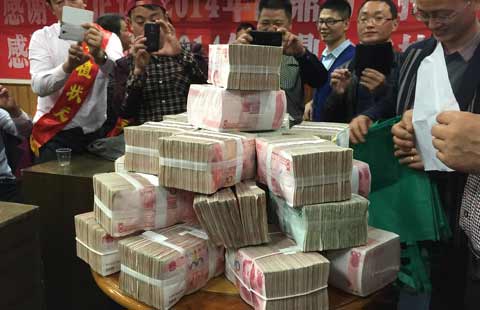
NANNING - Liao Rongna is one of Interpol's most wanted men. He does not run a drug cartel or lead a smuggling network. The Chinese billionaire owns a conglomerate with interests in automobiles, construction and logistics.
Interpol issued a red notice for Liao because he ran away from a debt of 3.2 billion yuan ($522 million). Liao, 58, is said to have cheated his way into billions in loans by promising investors high returns, and then failing to repay the debt. A guilty verdict for this kind of crime in China can result in the death sentence.
For Liao, a life of burning through other people's money was better than dealing with bankruptcy and the wrath of domestic law. So he chose to flee the country, a common way out for rich Chinese who borrow with the promise of high returns, but later run out of money to pay their debts.
The rising number of runaway billionaires reflects the financing difficulties facing the Chinese private sector, according to analysts.
Ma Jun, chief economist at the Research Bureau of the People's Bank of China, told Xinhua the borrowing rate for Chinese small and medium enterprises (SMEs) is usually around 20 percent. The interest rate an SME needs to pay often surpasses its profit margin.
In nominal terms, China's financing costs are not high compared with the country's GDP growth and industrial profit margins. The benchmark rate for one-year bank loans is only 5.6 percent.
The benchmark rate, however, is reserved for state-owned and big corporations, and SMEs usually face significant mark-ups.
Liu Gang, general manager of an auto parts company in Guangxi's Liuzhou City, said banks hike the rates for SMEs with the help of special terms and shadow banking lenders.
According to Liu, banks often request a SME borrower put half of the loans they have received back in deposits, but ask the borrower to pay interest on the total amount.
"Our financing cost is then doubled," Liu said, adding that the practice, though banned, still occurs.
Despite the high rates, most Chinese SMEs cannot actually get loans from banks. They only receive funding from shadow banking institutions, often with annual interest rates around 24 percent, said Liu Qiao, a professor of finance at the renowned Peking University.

Copyright 1995 - . All rights reserved. The content (including but not limited to text, photo, multimedia information, etc) published in this site belongs to China Daily Information Co (CDIC). Without written authorization from CDIC, such content shall not be republished or used in any form. Note: Browsers with 1024*768 or higher resolution are suggested for this site.
License for publishing multimedia online 0108263 Registration Number: 130349