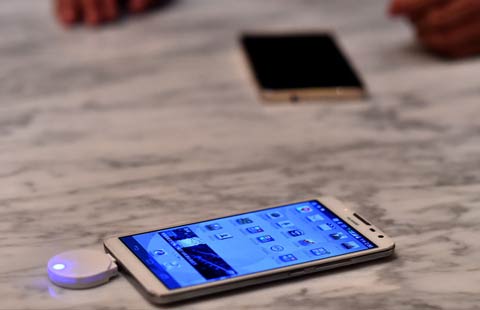
Guo Lie's app Lian Meng, which literally means "cute face", was a perfect example last year when it suddenly swept across China's social networks in one month.
The app allows users to turn their pictures into cartoons on social networking apps. It saw an unbelievable increase of about 6 million users within a single day in June last year. The craze lasted for a month, with dozens of millions of users, but it has slowed down gradually. Still, Guo's app lingers on the list of China's top-50 apps.
The 26-year-old's team has no more than 10 employees. All of them are aged 26 or younger. Before he launched his startup, Guo worked for China's Internet giant Tencent for one year.
Like Guo, young entrepreneurs with fresh ideas that aim to make a fortune from mobile Web have been springing up across China. They design social network apps that target different demographics, from MOMO, a Tinder-like app for strangers, and wumi (no secret), a social network in anonymity, to service-oriented apps like taxi-hailing app Didi and Kuaidi, the Chinese version of Uber.
While mobile Web business is growing, a new wave of apps that provides online to offline (O2O) services is also taking shape.
Pu Qiantong is the first to take the offline market of traditional Chinese massage service into the mobile web. With her app Huatuo Jiadao (Huatuo's Coming - Huatuo is well known as a great physician in ancient China), mobile users can order house calls from a traditional Chinese medicine therapist, instead of having to arrange an appointment to visit a massage club in person.
A user can see from the app a therapist's previous work experience, the distance the therapist has to travel to his or her apartment and the assessment of the therapist's skills by others who have used his or her services.
Pu says her company has signed up about 100 therapists to provide home massage service in Beijing and Shanghai. Launched at the end of last December, the app had more than 5,000 mobile customers within one month.
The one-month-old app has just received a 10 million yuan investment. It plans to attract users in 10 more cities in China this year.
"Online to offline service in mobile web market is definitely hot and popular. I expect more startups to come up this year," says Pu.
Pu, 30, leads a team of about 30. She is confident of the success of her app since Chinese people, especially those living in big cities, have a habit of going to a therapist for body or neck massage.
Pu's confidence may also come from the good performance of another O2O app, Helijia, which allows users to order home manicure service.
The app gets an average of 6,000 orders daily from its users after its launch last March. Its founder Meng Xin had succeeded in running a brand of essential oil on a website and a restaurant using social networks, before setting up the nail beauty app.
Experts say the rise of O2O services in mobile web can be attributed to the switch of Chinese consumers' payment habit from using money to making electronic payment.
Copyright 1995 - . All rights reserved. The content (including but not limited to text, photo, multimedia information, etc) published in this site belongs to China Daily Information Co (CDIC). Without written authorization from CDIC, such content shall not be republished or used in any form. Note: Browsers with 1024*768 or higher resolution are suggested for this site.
License for publishing multimedia online 0108263 Registration Number: 130349