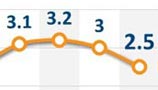
China's foreign trade got off to a rocky start in 2015, declining 10.8 percent in January compared with the previous year to 2.09 trillion yuan ($334.4 billion), according to figures by the General Administration of Customs. Exports reached 1.23 trillion yuan, a 3.2 percent drop, while imports nosedived by 19.7 percent to 860 billion yuan. After seasonal adjustments, the decline in all three categories narrowed somewhat, but still fell into the red.
The January performance came amid declines in the manufacturing sector and a general slowdown in the economy. The purchasing managers index, a gauge of the manufacturing industry, stood at 49.8, pointing to a contraction in business. Recently, the central bank lowered the required reserve ratios for banks and other financial institutions, an indication that policymakers were convinced that the economic slowdown was steeper than expected.
China's foreign trade sector will face mounting pressure this year. It is stuck in a transitional situation - one in which the old growth momentum built on easy credit and low costs is a thing of the past - but new impetus generated by added value, branding and services is still being shaped. During this painful and long-term transition, China's foreign trade will grow slowly, with occasionally monthly declines.
Entering 2015, most of China's major export markets were not performing well. The economies of the European Union, Southeast Asia, Japan, South Korea and Australia either shrank or slowed down, resulting in declines in China's trade with these economies in January. China's trade dropped 5.3 percent with the EU, 0.6 percent with the Association of Southeast Asian Nations, 17.3 percent with Japan, 9.7 percent with South Korea and 26.8 percent with Australia. The weakness in global demand is evident.
The United States was China's only major trading partner that registered growth in January, at 0.5 percent. The US economic recovery is solid, but unfortunately, there is less of a correlation between the US economic recovery and its trade performance with China because of the US' efforts to revitalize its manufacturing industry and relocate production chains.
If the global recovery remains fragile throughout the year, China's trade may find it hard to achieve the yearly growth target of 6 percent.
Domestically, a January decline in imports reflects weak demand in consumption and production. That trend might continue for some time because top policymakers appear to be refraining from proactive fiscal and monetary stimulus measures.
And a drop in exports means that new capital expenditure will be slashed across many sectors. For China, sluggish overall trade will put a dent in its economic prospects.

Copyright 1995 - . All rights reserved. The content (including but not limited to text, photo, multimedia information, etc) published in this site belongs to China Daily Information Co (CDIC). Without written authorization from CDIC, such content shall not be republished or used in any form. Note: Browsers with 1024*768 or higher resolution are suggested for this site.
License for publishing multimedia online 0108263 Registration Number: 130349