BEIJING - A deep look into China's most recent power consumption data may stir concerns over a slowing economy, but the shrinking figures could also indicate a transition taking place in economic structure, analysts say.
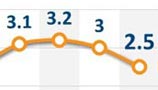
Official data showed electricity consumption, an important indicator of economic activity, grew only 0.8 percent year on year to 1.29 trillion kilowatt hours in the first quarter, down 4.6 percentage points from the same period last year.
The weakness accompanied other key economic indicators, including investment and industrial output, which both fell below market expectations. The economy grew at the lowest quarterly growth since 2009, expanding 7 percent in the first quarter.
However, a detailed analysis of the power data reveals some encouraging trends in the economy such as a growing tertiary industry and energy conservation efforts making progress.
The service sector consumed 7 percent more power from a year ago in the first quarter and power use for residential purposes gained 2.6 percent.
The service sector, which grew much faster than the industrial sector and the economy as a whole, accounted for 51.6 percent of GDP in Q1, up from 48.2 percent in 2014 and 46.9 percent in 2013, according to data from the National Bureau of Statistics (NBS).
The slowdown in power consumption was also due to the nation's energy conservation efforts, NBS spokesman Sheng Laiyun said this week. The NBS data showed energy consumption per unit of GDP continued to fall, marking a drop of 5.6 percent in the first quarter after last year's 4.8-percent decline.
According to analysts, the decelerating power consumption growth was mainly the result of declines in the secondary industry, which saw power consumption fall 0.7 percent in Q1 and dive 4.1 percent in March.
"The slowed increase of power consumption in Q1 suggested rising downward pressure of the industrial economy," said Ouyang Changyu, deputy secretary-general of the China Electricity Council (CEC).
Major energy-intensive industries account for 30 percent of China's general industrial output, however, they use more than 60 percent of electricity for industrial production, according to NBS data.
When the economy slows, the slowdown in heavy industries will result in a strong negative impact on power consumption, Sheng said.
Power consumption in the ferrous metal industry, for instance, edged down 5.6 percent year on year during the Jan-Feb period, along with decreases in other high energy-consuming sectors including chemical, non-ferrous metal and building materials, according to the CEC.
The divergence in power use among different industries was evidence of the transformation in the Chinese economy, said Shan Baoguo, a researcher at the Energy Institute with SGCC (State Grid Corp of China), China's largest power distributor.
Shan said it suggested traditional sectors, with heavy reliance on power use, are slowing, whereas high-end equipment manufacturing is becoming a new engine of growth.
While the nation's industrial output grew 6.4 percent year on year in the January-March period, the industrial structure continued to improve. The industrial value added of the high-tech sector and equipment manufacturing jumped by 11.4 percent and 7.7 percent respectively in the first quarter, outpacing overall growth.
In the long term, national power consumption will shift from the double-digit growth to a medium growth of 4 percent to 6 percent as a result of the change from high-speed growth to medium-high growth of Chinese economy, Ouyang predicted.

Copyright 1995 - . All rights reserved. The content (including but not limited to text, photo, multimedia information, etc) published in this site belongs to China Daily Information Co (CDIC). Without written authorization from CDIC, such content shall not be republished or used in any form. Note: Browsers with 1024*768 or higher resolution are suggested for this site.
License for publishing multimedia online 0108263 Registration Number: 130349