Monetary easing is not a magic cure for China's economic malaise, as it does little to solve the chronic disease of overcapacity, said an independent report published by the Cheung Kong Graduate School of Business.
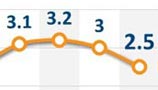
The quarterly industrial economy survey by the school's finance professor Gan Jie showed that after stabilizing in the first quarter, China's industrial economy did not improve in the second quarter. The Business Sentiment Index, a key indicator in the survey, declined to 47 from the first quarter's mark of 50, indicating a slight contraction. Fixed investments remained sluggish, with only 9 percent of the firms surveyed making investments.
According to the study, about 55 percent of the respondents cited "lack of orders" as the key factor behind constrained manufacturing. Higher labor and raw material costs were the second and third factors, at 14 percent and 10 percent, respectively. Only 3 percent of the respondents considered "financing" as a bottleneck.
The report, based on responses from 2,000 companies with annual sales of more than 5 million yuan, ($784,000), found that most of the lenders had a generally accommodative attitude toward lending, with only 5 percent thinking otherwise.
Among firms that did not seek fresh funding in the past quarter, a vast majority (92 percent) said they did not require the same.
On the other hand, overcapacity deteriorated dramatically in the second quarter. As many as 53 percent of the respondents indicated that supply exceeded demand, the highest record since the survey started in the second quarter of 2014.
Firms reporting an over 10 percent overcapacity surged drastically from 6 percent in the first quarter to 32 percent in the second, while firms reporting an over 20 percent overcapacity surged from 2 percent to 17 percent.
Severe supply glut undermined firms' bargaining power, thus squeezing their profitability. A majority (42 percent) of the firms surveyed reported a 10 to 15 percent gross margin, while the second largest group reported a 5 to 10 percent margin.
Gan said with such low profitability, banks have adequate reasons to decline funding requests.
"Public perception is that it is difficult to borrow money from banks, something that constrained the real economic growth. But with such a low profitability, banks shouldn't lend to these enterprises at all in the first place.
"Warren Buffett said he wouldn't consider investment targets with a margin below 40 percent. I am sure that most Chinese manufacturing firms would not be in his investment radar," she said.
Recognizing weak aggregate demand as the key problem, Gan said long-term policy measures that can boost the aggregate demand and upgrade industrial competitiveness are necessary.

Copyright 1995 - . All rights reserved. The content (including but not limited to text, photo, multimedia information, etc) published in this site belongs to China Daily Information Co (CDIC). Without written authorization from CDIC, such content shall not be republished or used in any form. Note: Browsers with 1024*768 or higher resolution are suggested for this site.
License for publishing multimedia online 0108263 Registration Number: 130349