A year ago, Premier Li Keqiang told the World Economic Forum that his country could avoid a hard landing. Nobel laureate Joseph Stiglitz and Credit Suisse Group AG Chief Executive Officer Tidjane Thiam, who attended this year's forum held last week in the Swiss town of Davos, said he is still right.
Their stance clashes with the recent sentiment in financial markets, where a sell-off of the yuan and Chinese equities sent shockwaves through commodities markets and helped wipe $5 trillion off stocks worldwide by reviving fears over the global growth outlook.
"Sentiment has likely lurched far too quickly into a bearish posture and over-hyped downside scenarios," said Tim Adams, the United States Treasury's former point-man on China and now president of the Institute of International Finance. "In the end, China will likely emulate every major economy and muddle through."
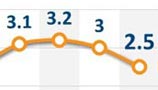
Investors are increasingly concerned about China as a report released last week showed its economy grew last year at the weakest pace since 1990. Further spooking investors is a debt overhang estimated at $28 trillion, currency weakness that risks spurring competitive devaluations elsewhere, and equities' decline into a bear market.
With China now the world's No 2 economy and responsible for about 15 percent of global output, the worry is that its troubles will spread to other nations as it cuts imports of commodities and manufactured goods. A weaker yuan also threatens to deal another disinflationary blow.
Some economists counter that there is reason for optimism as Chinese consumers are still spending, property prices are stabilizing, demand for exports has picked up and there is plenty of room for fiscal and monetary stimulus if required. Though growth is indeed fading, China is on track to expand 6.5 percent this year, according to the median estimate of economists surveyed by Bloomberg.
"There's always been a gap between what's happening in the real economy and financial markets," said Stiglitz, a professor at Columbia University who attended the Davos forum. "What's happening in China is a slowdown by all accounts," he said, "but it's not a cataclysmic slowdown."
To Adam Posen, president of the Peterson Institute for International Economics, the situation is akin to the US savings and loans crisis in the 1980s, which hurt but did not cripple the economy. Chinese citizens still have savings, the country has little debt denominated in foreign currency, and banks are displaying no signs of instability, he said.
"I think people are over-reacting," said Posen, a former Bank of England policymaker. Even under more adverse conditions in China, the spillover will be limited to about 0.2 percentage point of GDP in the US, Europe and Japan, Goldman Sachs Group Inc economists said in a report this month.
Some argue that the pain will ultimately pay off as China shifts to a more sustainable expansion focused on consumption and services rather than investment and manufacturing.
"Yes there will be growing pains, yes they're changing their model from export-led capital intensive growth to consumerism, but I think they'll manage," Credit Suisse's Thiam said. "I went to China first in 1984-anybody who's been to China in 1984 can only be a China bull."

Copyright 1995 - . All rights reserved. The content (including but not limited to text, photo, multimedia information, etc) published in this site belongs to China Daily Information Co (CDIC). Without written authorization from CDIC, such content shall not be republished or used in any form. Note: Browsers with 1024*768 or higher resolution are suggested for this site.
License for publishing multimedia online 0108263 Registration Number: 130349