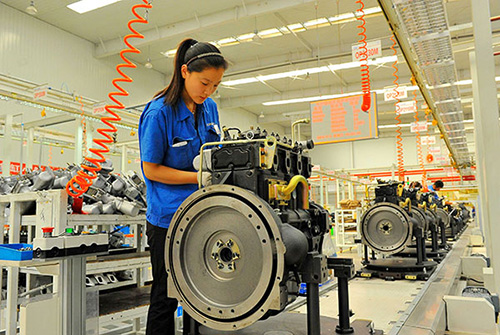
GUANGZHOU - In Dongguan City, a dark, cobweb-filled workshop shows no signs of the activity it saw a year ago, when 650 workers polished mobile phone cases moving along 10 conveyor belts.
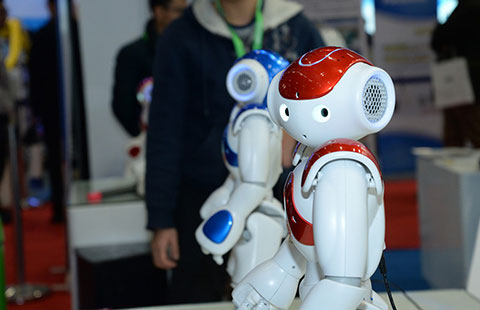
Today, the tasks are performed in the room next door by 60 robot arms. The mechanical limbs produce fewer duds and never get bored. Only 30 employees are needed to supervise the machines.
It was the first step for Everwin Precision Technology, which owns the plant, in replacing workers with machines, said company chairman Chen Qixing. The company aims to use 1,000 robotic arms to automate 80 percent of its manufacturing by 2017.
Everwin is among more than 1,000 manufacturers that have adopted automated helpers to reduce their heavy reliance on labor in Dongguan, a leading production base for garments and gadgets. The southern Chinese city in Guangdong province has been called the "world's factory" and is a barometer for the country's economic changes.
China is the world's largest market for industrial robots, accounting for a quarter of global sales, according to the International Federation of Robotics.
The move toward automation has seen a major government push. Intelligent manufacturing is the core of the country's "Made in China 2025" plan to upgrade industry, and robotics is also mentioned in the country's new five-year plan, which will guide national economic development for 2016-2020.
Cheaper, better
A government work report delivered to local legislators in late February said Dongguan aims to become a trailblazer of China's robotics industry and an advanced manufacturing base with global clout.
Since the 1980s, the city has become a center for contract manufacturing, churning out toys, clothing and electronics for overseas brands. However, it bore the brunt of the 2008 global financial crisis due to weakening competitiveness resulting from dependence on cheap labor and a lack of research and development.
In September 2014, pressured by a persistent labor crunch and surging wage bills, Dongguan started its push into automation, providing subsidies for manufacturers' "machine for man" programs.
Manufacturers are facing a shortage of 200,000 workers, even though the city's minimum salary doubled between 2010 and 2015.
Nationwide, the labor pool is shrinking. The working-age population between ages 16 and 59 was 4.87 million less in 2015 than the previous year, marking a drop for the fourth straight year, according to the National Bureau of Statistics. Former head of the bureau Ma Jiantang said the declining trend will continue until 2030.

Copyright 1995 - . All rights reserved. The content (including but not limited to text, photo, multimedia information, etc) published in this site belongs to China Daily Information Co (CDIC). Without written authorization from CDIC, such content shall not be republished or used in any form. Note: Browsers with 1024*768 or higher resolution are suggested for this site.
License for publishing multimedia online 0108263 Registration Number: 130349