BEIJING - What's the easiest way to get a comprehensive picture of China's economy and society?
"The five-year plan" is one possible answer.
Since 1953, China has produced 13 five-year plans.
These blueprints for national economic and social development are receiving ever increasing praises abroad as Chinese wisdom worth learning from.
The 12th Five-Year Plan for National Economic and Social Development (2011-2015) is a good example, as the country fulfilled all the major tasks and targets as planned.
The 13th Five-Year Plan for the 2016-2020 period, approved on Wednesday by the National People's Congress (NPC), China's parliament, is a new chance to examine how the world's second largest economy forecasts its future, plans its goals, deal with challenges and transform itself.
Here is a summary of the highlights in the 12th and 13th five-year plan decade.
Economic engines
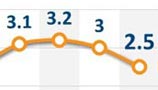
The Chinese economy managed an average 7.8 percent annual growth over the past 5 years, while many developed nations still struggled to recover.
In 2010, China's GDP was $5.9 trillion, overtaking Japan as the world's second-largest economy. In 2015, its GDP rose to $10.42 trillion, accounting for 14.4 percent of global GDP.
The 13th five-year plan sets a growth target range from 6.5 percent to 7 percent a year, and forecasts China's GDP will exceed $14 trillion in five years, continuing as the world's economic engine and narrowing the gap with the United States.
Hu Angang, an economist with Tsinghua University, forecast China's per-capita GDP will be $10,000 by 2020, and the gap between the two biggest economies in per-capita GDP will close from one seventh to one third.
Some foreign analysts say China's emergence as the biggest economy is only a matter of time.
Great changes
In 2010, when Xiaomi was founded, the Chinese smartphone market was dominated by foreign brands. Newspapers splashed photos of people queuing for Apple's iPhone 4 and few would consider buying handset from a domestic startup.
Five years later, Xiaomi, with a market value estimated at $45 billion, was China's leading smartphone vendor and ranked very high in the global market.
The smiling face of its founder has frequently graced the pages of the Wall Street Journal and Forbes, while Wired stated "It's time to copy China."

Copyright 1995 - . All rights reserved. The content (including but not limited to text, photo, multimedia information, etc) published in this site belongs to China Daily Information Co (CDIC). Without written authorization from CDIC, such content shall not be republished or used in any form. Note: Browsers with 1024*768 or higher resolution are suggested for this site.
License for publishing multimedia online 0108263 Registration Number: 130349