|
|
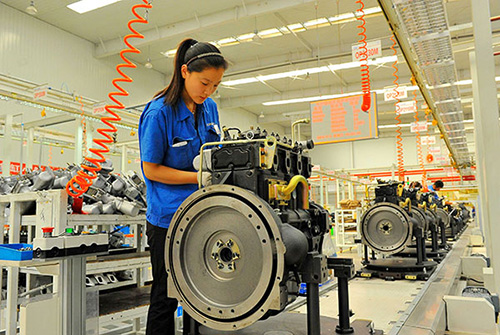
Students learn how to process car components at the vocational education training center of BMW Brilliance Automobile Ltd in Shenyang, Jilin province. [Photo provided to China Daily] |
Li Xiaojian has worked manual jobs for more than 40 years, doing everything from harvesting wheat to driving a truck. What he is most proud of is that his son graduated from college and found a white-collar job four years ago. "I hoped his life would not be as hard as mine, and the key would be education. I saw that people with better education have more and better options in the job market," said the 57-year-old from Shaanxi province, who only finished junior high school.
Li's expectations for his son are much like those of the Chinese government for the country's workforce. The world's second largest economy aims to raise the average number of years of education its working-age population receives by 0.57 years to 10.8 years in five years, according to the draft outline of the 13th Five-Year Plan (2016-20) released this month.
Improving labor quality is pivotal to countering China's weakening demographic dividend by raising productivity. It will also help with the country's ascent to becoming a global manufacturing power.
With seemingly limitless labor supply, the country's working-age population between the ages of 16 and 59 saw a drop for the fourth straight year in 2015, the number of which was 4.87 million less than in 2014, according to the National Bureau of Statistics.
China aims to increase labor productivity by more than 6.6 percent yearly on average from 2016 to 2020, to be achieved through improved workforce quality and technology.
"We're talking about how to transform from 'made in China' to 'created in China.' It is high-quality workers who can fulfill the transformation," said Wang Yuhu, who is attending the ongoing annual legislative session.
Workforce education will also help stabilize the job market amid slowing economy, said Li Chang'an, a professor of public administration with the University of International Business and Economics.
Despite the shrinking labor pool, securing a job in a city is not easy in the face of downward pressure in the economy, which grew 6.9 percent last year, the slowest annual expansion in a quarter of a century.
A government work report delivered on March 10 at the legislative session said the country aims to create at least 10 million new urban jobs and keep the registered urban unemployment rate within 4.5 percent in 2016.
The targets are unchanged from those for last year, while the growth target for this year is in the range of 6.5 and 7 percent and last year's was "around 7 percent."
In addition, the government will work to relocate 1.8 million workers in the coal and steel sectors who will be laid off as a result of industrial overcapacity reduction. About 100 million rural people who are expected to settle in cities by 2020 will also compete for jobs.
"Under such conditions, better education will be an important advantage for job-seekers," said Li Chang'an.
Although his son works as a department manager of a private firm, Li Xiaojian cannot rest easy about the young man's future.
Last month, the father left his job as a truck driver because of his age, but went back to toil on his farmland. He said he is saving money to help buy a home for his son in Xi'an City, capital of Shaanxi.
"Buying a house isn't easy, even for a man with a decent job like him. The price is just too high," he said.

Copyright 1995 - . All rights reserved. The content (including but not limited to text, photo, multimedia information, etc) published in this site belongs to China Daily Information Co (CDIC). Without written authorization from CDIC, such content shall not be republished or used in any form. Note: Browsers with 1024*768 or higher resolution are suggested for this site.
License for publishing multimedia online 0108263 Registration Number: 130349