HANGZHOU -- As leaders of the world's major economies are to gather in Hangzhou, all eyes are on China to see what the economic powerhouse can offer in global governance to revive the world economy.
On September 4-5, President Xi Jinping will host the Group of 20 (G20) summit, which bears the theme of "Toward an Innovative, Invigorated, Interconnected and Inclusive World Economy."
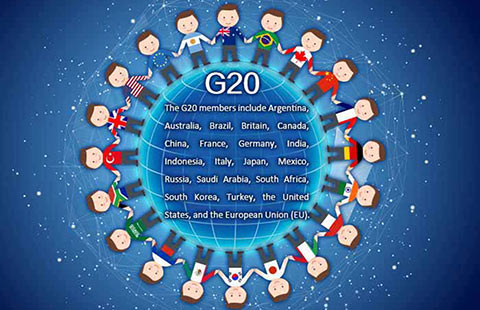
The G20 represents over 85 percent of the world's economy and two thirds of global population. China took over the G20 presidency of the group in December 2015.
The most urgent task facing the G20 summit is to achieve a steady recovery in the world economy and guard against economic crises caused by accumulated financial risks.
Yet equally important are efforts to reform global economic governance.
Eight years ago when the first G20 summit was held in Washington, global governance was an unfamiliar term to most Chinese.
The term became part of Chinese political parlance in the course of addressing the 2008 global financial crisis and has gained prominence in the past years.
Attending a BRICS summit in South Africa in March 2013, about two weeks after taking office as the top Chinese leader, President Xi Jinping spoke of the need for emerging economies to take part in global governance, to uphold international fairness and justice and safeguard world peace and stability.
"No matter how the reform of the global governance system may unfold, we should always take an active and constructive part in the process," Xi said.
Emphasis on global governance is now a hallmark of China's diplomacy.
In St. Petersburg in September 2013, Xi called on major countries to adopt responsible macroeconomic policies and improve global economic governance to maintain and promote the openness of the world economy at the eighth G20 summit.
In Brisbane in 2014, he urged G20 members to improve global economic governance and strive for a fair, just, inclusive and orderly international financial system.
He said efforts should be made to increase the presence of developing countries and emerging-market economies and offer them a bigger say in international systems, and ensure the equality of different countries in global economic cooperation in terms of rights, opportunities and rules.
The call was renewed at the G20 summit in Antalya last year.
"We need to increase the representation and voice of the emerging-market economies and developing countries (in global governance), so as to enhance the capabilities of the world economy to resist risks," Xi said.
Global governance also features heavily when Xi addresses domestic audience.
In early July, in a speech marking the Communist Party of China's 95th anniversary, Xi said that China should actively participate in building global governance and strive to contribute Chinese wisdom to the improvement of global governance.
"It's for the people of all countries to decide through consultations what international order and global governance systems can benefit the world and people of all nations," he said.
"China will work with people of all countries to push the world order and global governance system toward a more just and reasonable direction."
The rationale behind China's increasingly active participation in global governance is not difficult to understand.
"With China's rise, it is only logical that the country plays a bigger role on the global stage," said Xu Guangjian, deputy director of the School of Public Administration and Policy at the Renmin University of China.
"This development is in line with China's deepening affirmation of globalization, and its realization that no country, including China, could stand unaffected in the wake of the 2008 global financial crisis," Xu said.
The remarks were echoed by Douglas Paal, vice president for studies at the Carnegie Endowment for International Peace, a Washington-based think tank.
"China has a big and growing interest in maintaining and strengthening the international economic and trading system," Paal said.
Without doubt, the G20 constitutes an important platform for China to turn its vision for global governance into reality.
In 2008, China's then president Hu Jintao told the first G20 summit in Washington that "steady and relatively fast growth of China's economy is in itself an important contribution to international financial stability and world economic growth."
Now the country has much more to offer.
For many, the G20 Hangzhou summit has come to the "right country at the right time."
Though slowing, China's GDP growth was 6.7 percent in the second quarter of this year, within the government's target range of 6.5 percent to 7 percent for 2016, and was accompanied with progress in structural economic improvements. The country contributed to over 25 percent of global growth in 2015.
While the lingering fog of international financial crisis has yet to clear, collective action for inclusive and innovative growth - characteristics that define the Chinese solution to the world economy - has emerged as a guiding light to help countries navigate choppy economic waters.
The Chinese proposals today are similar to those that Chinese leaders proposed at G20 summits for years: reform in international financial institutions, innovation in growth patterns, coordinated macro policy and an open world economy.
China's practices, such as innovation-driven development and ongoing supply-side structural reform, can thus offer inspiration to the world.
Meanwhile, with such inclusive programs as the Belt and Road Initiative and the Asian Infrastructure Investment Bank (AIIB), China is showing that it is committed to connecting regions and countries, while at the same time creating opportunities.
Though no instant cure is expected for the world economy, a common strategy for global governance is needed to initiate a new beginning for sustainable development. This is what China hopes to achieve at the summit.


Copyright 1995 - . All rights reserved. The content (including but not limited to text, photo, multimedia information, etc) published in this site belongs to China Daily Information Co (CDIC). Without written authorization from CDIC, such content shall not be republished or used in any form. Note: Browsers with 1024*768 or higher resolution are suggested for this site.
License for publishing multimedia online 0108263 Registration Number: 130349