|
|
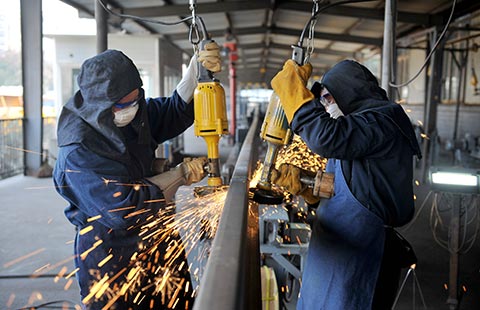
China will raise its emission standards and improve fuel quality in the coming years. [Photo provided to China Daily] |
China is speeding up its upgrading of vehicle emission standards to control car exhaust pollution, an alleged culprit for the smog that shrouds nearly half the country on many winter days.
The 11 provinces in East China, where the economy is more advanced than the remainder, are required to put the new emissions standards into effect from April, nine months earlier than originally planned.
Those provincial regions are Beijing, Tianjin, Hebei, Liaoning, Shanghai, Jiangsu, Zhejiang, Fujian, Shandong, Guangdong and Hainan.
On Jan 18, the Ministry of Industry and Information Technology and the Ministry of Environmental Protection published the sub-regional timeline for implementing the National V emission standard.
The standard is similar to the Euro V standard, and requires sulfur content in fuel to be no more than 10 parts per million, one-fifth of the National IV's 50 ppm requirement.
According to the ministries' notice, all light petrol vehicles, light diesel buses, and heavy diesel vehicles (for the purposes of public transportation, environmental sanitation and postal services) must comply.
The notice calls for nationwide implementation of the National V standard for light petrol vehicles and heavy diesel vehicles used for public transportation, environmental sanitation and postal services from Jan 1, 2017.
It also requires all heavy diesel vehicles across the country to meet the standard from July 1, 2017. All light diesel vehicles throughout China must conform to the standard from Jan 1, 2018.
The notice said that companies that produce or sell vehicles that cannot meet the standard would be fined. The Ministry of Environmental Protection will also strengthen its supervision of fuel quality.
Beijing has implemented its Capital V standard, which is stricter than the National V, for light petrol vehicles since February 2013.
A corresponding Capital V standard for heavy petrol vehicles, which was supposed to be implemented at the same time, was postponed until June 1, 2015.
Tianjin put the National V standard in place for light petrol vehicles in September. It also stopped selling heavy diesel vehicles that could not meet the standard.
Hebei province is still using the National IV standard, which is seen as a major obstacle to improving air quality and controlling pollution in the area.
The ministries' announcement is expected to make the province, which borders the capital, greener.
The country plans to continue to raise its emission standards.
Pei Xiaofei, a senior official from the department of science, technology and standards in the Ministry of Environmental Protection, said a few months earlier that the ministry is drafting a National VI standard, which will be 30 percent lower than National V standard in terms of nitric oxide and particles emissions.
He said the ministry attaches great importance to implementing the National VI standard, and plans to put it under administrative examination this year.
Beijing released the draft of an ambitious emissions plan, Capital VI, in November for public opinion, which was controversial as it is much stricter than Capital V.
The municipal government set the goal of reducing 20 to 30 percent of the city's pollutant emissions caused by vehicles by 2022, which is supposed to be carried out by Dec 1, 2017.
Dong Yang, executive vice-president of the China Association of Automobile Manufacturers, believes the Capital VI standard goes against the interests of consumers.
"I agree with the stricter than current emissions standard applied in Beijing, but not Capital VI, as it is illegal," Dong said in November, shortly after the release of the Capital VI draft.
He believes quality fuel supplies are the key of reaching emission standard. Low-quality fuel results in a failure to meet emission standards, and possible vehicle damage.
Moreover, he said, China should implement a single unified emission standard across the country, instead of a variety of standards in different regions.
He believes multiple emission standards in China will raise the cost of developing new models, ultimately leading to customers having to pay more to own a vehicle.

Copyright 1995 - . All rights reserved. The content (including but not limited to text, photo, multimedia information, etc) published in this site belongs to China Daily Information Co (CDIC). Without written authorization from CDIC, such content shall not be republished or used in any form. Note: Browsers with 1024*768 or higher resolution are suggested for this site.
License for publishing multimedia online 0108263 Registration Number: 20100000002731