Piety and a knowledge of Buddhist scriptures used to
qualify one to be a Chinese monk. Now, add computer skills, foreign language
ability and a degree in financial management.

Chinese Shaolin artists perform during
a show in Shanghai August 3, 2006.[Reuters]
Three decades after temples were destroyed and scriptures burned during the
Cultural Revolution, Buddhism is making a comeback in China.
And like most things in the super-competitive, rapidly developing country,
it's become both big business and a field in which people are eager to get
ahead.
That's creating a new breed of multi-tasking, tech-savvy, upwardly mobile
monks.
"Our recruiting process is highly competitive," said Hui Jue, deputy general
manager of the 120-year-old Jade Buddha Temple in downtown Shanghai. With his
head shaven and dressed in long, orange-brown monk's robes, he recently
completed a master of business administration degree at prestigious Jiaotong
University.
Fifteen monks from the temple have been sent to take foreign language courses
at the Shanghai International Studies University, and a second batch have
started MBA studies in the business school of Jiaotong University.
Such skills are necessary, Hui Jue believes, for the temple to both spread
Buddhist teachings in the modern world and manage its growing business
interests.
In addition to the temple grounds, Jade Buddha owns a vegetarian restaurant,
a four-star hotel with uniformed security guards to protect VIP guests, a
seven-floor office building and a food factory.
KUNG FU MONKS
Many of China's temples have been little touched by time, especially in
remote areas of the country. But Jade Buddha Temple's modern approach is no
longer unusual.
|
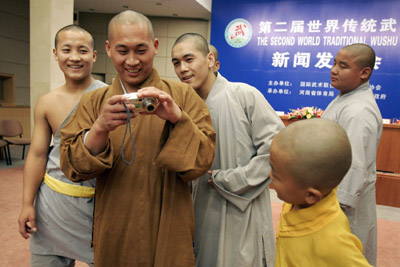
Shaolin monks look at their pictures on a
digital camera after a news conference in Beijing August 2, 2006,
announcing the Second World Traditional Wushu Championship to be held in
Zhengzhou in Henan province on October 15-19, 2006.
[Reuters]
|
Buddhism, introduced into China around the first century, is the biggest
religion in China with as many as 100 million adherents, over eight percent of
the Chinese population, according to some estimates.
China now has 13,000-some Buddhist temples and about 200,000 Buddhist monks
and nuns, according to the State Administration for Religious Affairs. The
number is believed to be rising.
Lucrative, fast-growing temples have also sprung up elsewhere in Asia, such
as in Taiwan and Thailand. But China's size and entrepreneurial flair may be
unmatched.
The ancient Shaolin Temple in Henan Province, for example, has capitalised on
its reputation as a birthplace of the martial arts to host glamorous
international guests and stage kung fu performances around the world.
In July, its abbot flew to Germany to watch the World Cup soccer final at the
invitation of FIFA president Sepp Blatter. Both soccer and martial arts can help
to promote world peace, the abbot was quoted as saying by the Xinhua news
agency.
Shaolin Temple has launched a money-making martial arts training school and
Shaolin Development Ltd., a company producing vegetarian snacks and Zen tea. The
temple also cooperates with entertainment companies in film-making and online
game production.
