Music companies shift IPR tactics
By Wu Jiao (China Daily)Updated: 2006-11-11 10:25
The country's first copyright infringement lawsuits against singing machine producers and sellers have been filed in Beijing No 2 Intermediate People's Court, officials with the court said on Friday.
| |||

The Music Copyright Society of China (MCSC) sued Xiamen-based Amoi Electronics as the company's PK-DVD 680 singing machines were sold to the market containing 20 songs that had not been copyrighted by the MCSC. The society is demanding Amoi pay 49,000 yuan (US$6,100) in compensation.
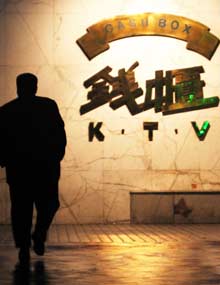 An outlet of Cashbox KTV in Shanghai. [newsphoto/file]  |
The case is still under investigation and the date of the first hearing has not been decided, said Gao Zhihai, an employee of the court.
Meanwhile, the court received a case in which Beijing-based children's music agent Kirin Kid Productions sued Changzhou-based Shinco Electronic Group Co, Ltd as its DG-900 singing machine contained copyrighted songs. Kirin Kid demanded 59,000 yuan (US$7,573) in compensation.
Wang Xuemei, market manager with Kirin Kid Productions told China Daily the two companies have already settled out of court.
Wang would not reveal the exact amount of compensation Shinco will pay.
The two cases are believed by legal experts to signal a new trend in IPR protection campaigns.
According to a judge surnamed Zhang in charge of IPR infringement cases, copyright holders used to prefer to sue KTV owners for IRP infringement.
But their lawsuits often failed as KTV owners claimed the singing machines had come with the songs preloaded, according to Zhang.
Legal experts such as Zhang expect the implementation of KTV copyright fees will ease the tension between copyright holders and music broadcasters.
The National Copyright Administration (NCA) said on Thursday that KTV club owners should pay a daily 12 yuan (US$1.5) copyright fee for each singing room. The decision came after a two-month soliciting of opinions from copyright holders, KTV goers and owners.
The fee programme will start in Beijing, Shanghai and Guangzhou before going
national, according to a notice posted on the official website of the
NCA.
|
||
|
||
|
|