Bank reserve ratio hiked to slow down investment
(China Daily/AP)Updated: 2007-04-06 06:48
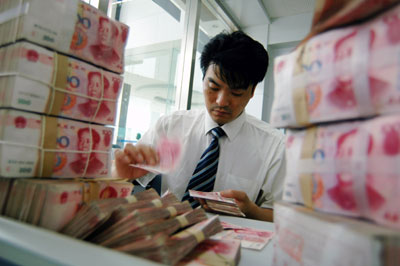 A clerk counts renminbi banknotes at a China Construction Bank branch in Haian, Jiangsu Province in this file photo. China told banks Thursday to increase their reserves for the third time this year, cutting the amount of money available for lending in a new effort to cool an investment boom. [newsphoto] |
China told banks Thursday to increase their reserves for the third time this year, cutting the amount of money available for lending in a new effort to cool an investment boom.
The reserve ratio for banks would rise by 0.5 percentage point starting from April 16, the People's Bank of China said Thursday.
After the increase, the ratio will be 10.5 percent for big bankers and 11 percent for smaller lenders.
The central bank intends to "maintain liquidity at an appropriate level and prevent the overly fast growth of credit," the bank said on its Web site.

"The move is directly aimed at mopping up excess liquidity," Zhao Xijun, finance professor at Renmin University of China, told China Daily, adding the ultimate objective is to maintain stable growth of the economy.
Chinese leaders want to maintain rapid growth in the economy, which expanded by 10.7 percent last year. But they worry that excessive investment in real estate, factories and other assets will leave banks with dangerously high debts if borrowers go bankrupt.
Despite the controls, total investment rose by 24 percent last year, according to government figures.
Beijing has raised the bank reserve ratio six times over the past year, each time by 0.5 percentage point. It stood at 7.5 percent of deposits before the first increase last June. The last increase was on Feb. 16.
Economists expect similar reserve increases once every quarter this year to compensate for the swelling amount of money in the banking system amid multibillion-dollar export surpluses.
In the first two months, China's trade surplus amounted to $39.61 billion, a stunning jump of 230 percent over the same period last year.
In February, M1, or cash in circulation and deposits, increased 21 percent year on year, a record high for the past 37 months, indicating increased liquidity pressure.
Meanwhile, banks have accumulated 11.1 trillion yuan ($1.44 trillion) of idle funds that can be used for lending.
In January and February, domestic banks extended new loans of 982 billion yuan ($127 billion), about 260 billion ($33.6 billion) more than a year ago.
On another front, the consumer price index rose to 2.7 percent, close to the warning line of 3 percent, in February.
"The central bank has been closely monitoring the growth trends of the economy and is taking preemptive measures to keep it on the right track," said Zhao.
Such a strategy is different from past years, when it seemed to have resorted to rather drastic measures to seek instant regulatory effect, said Zhao.
The central bank raised interest rates three times in the past year; the most recent of which came into effect on March 18.
Tang Min, chief economist with the Asian Development Bank in China, said yesterday that the adjustment in the reserve requirement ratio may be followed by another hike in the interest rate.
|
||
|
||
|
|