Xi 'travels in time' along the ancient trade route
Updated: 2013-09-10 23:14
By Wu Jiao (China Daily)
|
|||||||||


 |
|
President Xi Jinping, right, visits the ancient Ulugh Beg Observatory with the company of Uzbekistan's President Islam Karimov, center, in Samarkand, Uzbekistan, Sept 10, 2013. [Photo/Xinhua] |
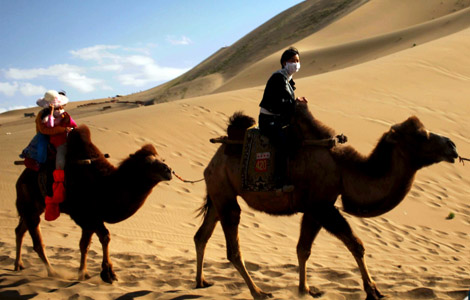
For many Chinese, the first impression of Samarkand — a city with a 2,500-year history and a major stop along the ancient Silk Road — are the camel bells echoing in the mountains and the wisp of smoke rising from the desert.
President Xi Jinping arrived in the city on Tuesday to pay tribute to the ancient Central Asian civilization.
This is the only sightseeing trip he has planned for his 11-day, five-country tour. Uzbek President Islam Karimov, who accompanied Xi during the visit to his hometown, introduced Xi to details about the ancient Silk Road.
Karimov especially mentioned to Xi that Xi'an, capital of Shaanxi, Xi's home province, was the starting point of the ancient Silk Road.
Xi said he got a sense of "being poetic".
"This gives us a special feeling. We are far away in distance, but we are also so near to each other in our soul. It is just like time travel," Xi said.
Samarkand, a major transit point on the ancient Silk Road and a gateway for China to Central Asia, has made important contributions to the exchanges between Eastern and Western civilizations. The ancient market at Registan Square in the city has witnessed many envoys, caravans, travelers, scholars and artisans traveling between East and West.
Grand buildings dating back to the 14th and 15th centuries stand testament to the prosperity and rich history that the city used to boast as the ancient capital of the all-conquering Timurid Empire.
And any Chinese visiting the city cannot help but marvel at the close links between China and the Central Asian region, bound in history. More than 2,100 years ago, during China's Western Han Dynasty (206 BC-AD 24), imperial envoy Zhang Qian was sent to Central Asia twice to open up China to the world of commercial trade and cultural communication.
His journeys opened the door to friendly contacts between China and Central Asian countries as well as the transcontinental Silk Road linking East and West, Asia and Europe.
The route linked traders, merchants, pilgrims, monks, nomads and dwellers from China to the Mediterranean Sea.
It got its name from the lucrative Chinese silk trade carried out along its length of more than 7,000 km. It was important for the development of Chinese civilization.
As ties between China and Central Asia evolve, the Chinese president has proposed building an economic belt along the Silk Road. It is the new strategy of China's new leadership in mapping out its Central Asia policy.
The economic belt, proposed by Xi last week during a key policy speech, could revitalize the ancient prosperous route. The belt is inhabited by nearly 3 billion people and represents the biggest market in the world with unparalleled potential. If realized, the economic belt will greatly benefit the people of all countries along the route.
But it won't be an easy task, and much work needs to be done.
Building transportation connections remains a challenge. The Shanghai Cooperation Organization, comprising China, Russia and Central Asian nations, is mulling over a major transportation route that would connect the Pacific and the Baltic Sea. This route connects East Asia, West Asia and South Asia to facilitate economic development and travel in the region.
But before the work is done, transportation will continue to be a problem. Trains from China have difficulty traveling on railways once they enter nations that were once part of the Soviet Union.
Airlines are not fully developed, either.
A friend of mine, who has to fly by herself to cover the trip, said there is only one flight between Uzbekistan and Kyrgyzstan every two days.
Related Stories
Silk Road to take on a new look 2013-09-10 23:22
Xi calls for closer China-Uzbekistan parliamentary exchanges 2013-09-10 03:22
Xi proposes a 'new Silk Road' with Central Asia 2013-09-08 07:25
President Xi proposes Silk Road economic belt 2013-09-07 14:02
Nations agreed to build New Silk Road 2013-09-03 07:16
Sisters are stars at Xi'an college 2013-09-10 02:01
Xi tables proposal on cooperation with Uzbekistan 2013-09-09 20:58
Xi extends festive greetings to teachers 2013-09-09 19:54
Xi leaves Kazakhstan to continue Central Asia tour 2013-09-08 20:04
Schedule