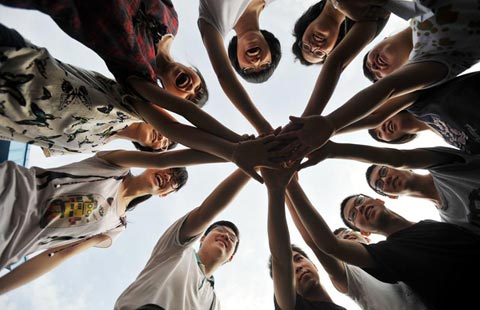
The unremarkable cultural life of the growing group that now numbers 269 million, or around one-fifth of the nation's population, was among concerns at the recent session of the Chinese People's Political Consultative Conference.
"They spend 2 percent of their total income on cultural activities," said He Xiangjiu, an author and CPPCC member who interviewed more than 100 migrant workers undercover in the past two years across the country and provided the above description of their life.
"And that's the best case," said He. "Many count watching TV as a cultural activity."
"They have nowhere to go," he added. "One worker I knew reread a worn-out magazine for three years."
According to He's research, 40 percent of migrant workers don't own a book, and 60 percent rate their cultural life as "unsatisfactory".
Cao Yong, a migrant worker and a deputy to the National People's Congress from Jiangsu province, said that the description of their plight is accurate, especially for young, unmarried workers.
"It's not that they don't want to see a movie, but it's too expensive," Cao said. "Most just go to an Internet bar."
He, the CPPCC member, drafted a proposal this year advising greater government involvement and an increase in public services, including low-price cinemas and theaters that target the group. He also is initiating a mobile library campaign in Cangzhou, Hebei province.
China already has invested some 70 billion yuan ($11.3 billion) in recent years in public cultural services in rural areas across the country for local libraries, free movie-screening, TV connections and such. So, nearly every village has some form of cultural activity.
"But once the villagers come into the city, they have no access to facilities," He said.
In the city, museums and libraries are mostly free. But workers from the countryside are often intimidated by urban facilities that are far different from the agricultural life to which they're accustomed.
"They're especially at a loss when first coming into the city, when they lose their traditional reference points and can't identify with the new ones," said Feng Jicai, an author, artist and CPPCC member. "They often feel looked down upon."
But that shouldn't be the case, and proper urbanization doesn't require total conversion, Feng said, adding that migrant workers and city dwellers should work together for a more inclusive cultural experience.
"Migrant workers should be proud of where they're from," Feng said. "Rural traditions are often the best, like being warm and kind-hearted to everyone. That's also the mentality the country calls for.
"For the group to truly be immersed in city life, they shouldn't let go of their own identity," Feng said. "Their folklore, their way of life and the way they carry on their traditions and morality should be kept and added to society."
"After all, these are the essence of Chinese culture. The whole society should be working on these values," Feng added.
Feng Shuangbai, vice-president of the Chinese Dance Association and a fellow CPPCC member, said: "It's especially important that incoming workers take part in cultural growth. Otherwise, urbanization will simply be soulless. And an empty cultural life will invite countless social problems."
Zhao Shengnan contributed to this story.
sunye@chinadaily.com.cn


Copyright 1995 - . All rights reserved. The content (including but not limited to text, photo, multimedia information, etc) published in this site belongs to China Daily Information Co (CDIC). Without written authorization from CDIC, such content shall not be republished or used in any form. Note: Browsers with 1024*768 or higher resolution are suggested for this site.
License for publishing multimedia online 0108263 Registration Number: 130349