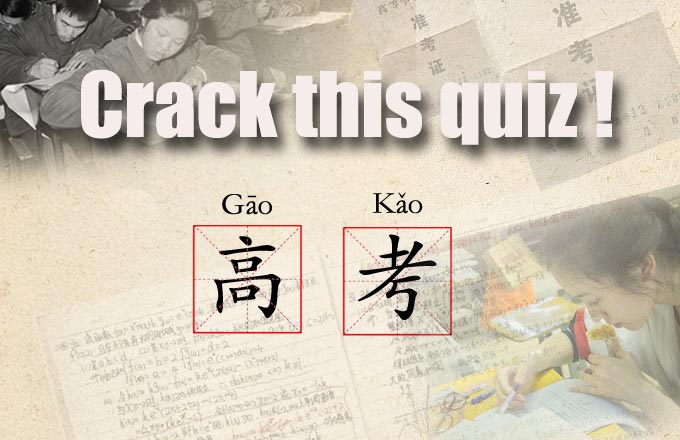
Reading test of entrance exam sparks hot debate
 |
|
Students prepare for this year's gaokao in Lianyungang, Jiangsu province.[Photo by Si Wei/China Daily] |
A conundrum of Chinese language reading test in the latest National College Entrance Examination or Gaokao in Zhejiang province has confused many students as well as the author of the text.
The test required students to choose the most accurate and appropriate analysis among the choices to explain why the author ended the story with a sentence stating that "the eyes of the fish flash with a glimpse of weirdness."
In his Weibo (China's equivalent to Twitter), Gong Gaofeng, author of the article selected for the test, wrote that he was no different than the students sitting the exam in being perplexed by the analytical choices on offer.
Gong is not the first author confused by the test of his own material. In 2011, a reading test in Fujian province asked the students to explain why the author twice described pelting rain in the article. However, the writer later told the media that it was simply because he had been writing the article while it was raining.
Although the entrance exam finished a few days ago, the debate on whether the reading analysis should go beyond an author's true intentions continues.
According to Gong, the final part of his story about the eyes of the fish was intended to salute to the style of the writer O Henry who often concluded his novels with mysterious or unexpected ending.
Yu Yonggang, director of Chinese language pedagogic team from Ningbo Chaiqiao High School, said, "The design of the particular multiple choice did not digress from the scope of required knowledge, as O Henry's endings are encompassed in the compulsory textbooks, while, the mysterious writing is one of the genre compiled in elective courses."
The excerpt from the novel chosen for the exam reflects the impoverished life in the past, which may, however, fail to resonate with the generation born after 2000, so that's why the question sounds difficult, he added.
According to the outline of Chinese exam, the test should be dedicated to evaluating a studen's abilities in reading, writing, reciting, analyzing and critical thinking. The examinees are tested for their competence in comprehending the spirit, aspirations and cultural values hidden between the lines of literary works, analyzing them by using different paradigms.
"As the exam is designed to select the most competent candidates, the answers of questions should always comply with certain standards," said Yu, "However, they should not be too rigid so to allow students to have different understandings and thoughts."
Speaking on why authors are often unable to answer the questions in the test featuring their own creations, Shi Shengxun, associate professor of the Department of Chinese Language and Literature in Peking University, said authors are not supposed to be involved in designing the questions.
This is a professional process, during which, the author's answer, despite its assurance and exclusiveness, may constrain the creativities of different minds and thoughts from the teachers responsible for charting the tests and students expected to sit in the exams, Shi said.
"What we insist on is to show an understanding of the reasons and logic behind every word, not absolute answers," he stressed.
Chu Zhaohui, researcher from the National Institute of Education Sciences, advised China to learn from foreign countries by introducing a better evaluation system to ensure the reasonableness of the entrance exams.
"We need rounds of discussions from groups of people before the exam papers are eventually fixed," Chu said.



- Reading test of entrance exam sparks hot debate
- Associates of fugitive billionaire Guo Wengui jailed for fraud
- In landmark experiment, Chinese scientists beam back 'entangled' photons from space
- Belt and Road Initiative legal study base launched in Beijing
- Miao people welcome experts in rural construction