Village protection plan preserves ancient culture
 |
|
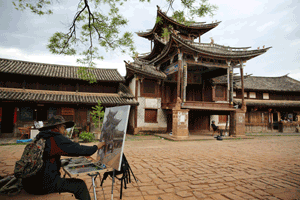
A stage for traditional opera often hosts performances in Zhoucheng village in Jianchuan county, Yunnan. WANG MINGWEI/CHINA DAILY |
Lack of support
The lack of financial support and low awareness of protection among villagers have exacerbated the problem, said Jin Hongna, an official with the Yunnan Housing and Urban-Rural Development Authority, who is overseeing the protection of traditional villages in the province.
Every traditional village will receive financial support of 3 million yuan a year from the government. However, the money is not intended for the protection and renovation of the villagers' houses, but for infrastructure upgrades, including roads and waste and sewage treatment facilities, Jin said, adding it's difficult for the government to become involved in the protection of privately owned houses.
"With poor ventilation and limited access to sunshine, living conditions in traditional houses built from wood and earth cannot be compared with those in modern, concrete houses. Without financial support, it can be hard to persuade the occupants to preserve their houses just by telling them the old properties are valuable," she said.
So far, the protection of Shaxi, an ancient township in Jianchuan county, Yunnan, has succeeded in the face of new challenges.
Shaxi was once an important hub on an ancient trade road from Yunnan to Tibet. The township fascinated members of the Swiss Federal Institute of Technology in 2000, when they participated in an investigative tour led by local officials. In 2002, the institute, based in Zurich, and the Jianchuan county government jointly launched the Shaxi Rehabilitation Project.
Yang Huiming, head of the township's cultural preservation department, said the Bai ethnic group has a tradition of dividing houses and passing them on to descendants, which helps to maintain the properties because no one is allowed to sell or demolish the houses without the approval of the other residents.
Initially, almost all the villagers were doubtful of the protection project because they thought poor living conditions were normal in these types of houses. "Nobody thought these houses were valuable because they didn't benefit from living in them at all," he said.
Zhang Jizhi, deputy director of the Jianchuan tourism commission, said sweeping changes happened after the local government bought some of the houses and brought in businesses to demonstrate how they could be put to practical use and improve livelihoods.
According to Zhang, many villagers only understood how valuable their houses were after the businesses began to attract tourists, and they have become "proactively" involved in protection efforts: "Some villagers have transformed their houses into guesthouses and transformed themselves into businessmen."
Yang said the ancient township now faces new protection challenges because the number of tourists sometimes exceeds capacity, and some businesspeople damaged the structure or style of some ancient houses when they renovated them.
Experts said the lack of a national protection mechanism and the government's long-term negligence of rural development also produce challenges for the preservation of traditional villages.
From 2001 to 2011, about 80 to 100 villages nationwide disappeared every day, according to Feng Jicai, a renowned writer and a member of the National Committee of the Chinese People's Political Consultative Conference, speaking at a news conference on culture at the fifth session of the 12th CPPCC National Committee in March. The 75-year-old author has spent decades researching the history of ancient traditional villages and campaigning for their protection.