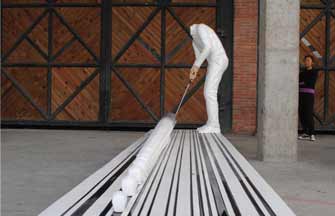
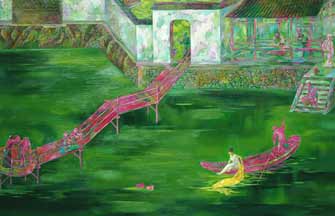
The concrete structures of the 798 Art Zone in northeastern Beijing stem from the North China Radio Equipment Joint Factory built with help from East Germany in the 1950s.
The radio factory was not the only one pushed out of the city when the capital began a dramatic transformation in the 1990s. Many large, empty workshops and warehouses were left behind, forming the original basis for the art zone.
In 2001-02, teachers and students from the sculpting department at the Central Academy of Arts were among the first artists to move into the former factory warehouses.
After American Robert Bernell moved his Timezone 8 art bookshop into a former factory cafeteria, attracted by the old factory's space, low rent and Bauhaus-influenced architectural style, more artists began to arrive and refurbished the venue with studios and galleries.
Most of the earliest arrivals selected the former Factory 798, inspiring the art zone's name. Early settlers in the zone, including Sui Jianguo and Hong Huang, had lived and studied overseas. With the international arts festival held in the first few years, the zone began to make headlines at home and abroad, but its popularity took off, domestically and internationally, with the arrival of foreign-funded galleries.
After 10 years of evolution, the zone is home to more than 500 art establishments from 26 foreign countries, including the United States, Italy, France and Belgium.
As the largest contemporary art zone in Asia, it has developed into a world-class venue for contemporary Chinese art. Along with the Great Wall and the Forbidden City, the zone can be found on almost every itinerary for foreign tourists. Its visitors include high-ranking political figures and celebrities from across the world.
The zone, which has been listed as one of the world's 22 best cultural landmarks by Time magazine, welcomes more than 3 million visitors annually, with 30 percent coming from overseas. Its prestige continues to increase in tandem with its commercial value. But as rents rise each year, many art institutions have been forced to move out.
With scores of high-end art businesses, fashion ventures and cafes setting up shop in recent years, the zone may be on the verge of becoming purely a commercial area.
|
 |
 |


Copyright 1995 - . All rights reserved. The content (including but not limited to text, photo, multimedia information, etc) published in this site belongs to China Daily Information Co (CDIC). Without written authorization from CDIC, such content shall not be republished or used in any form. Note: Browsers with 1024*768 or higher resolution are suggested for this site.
License for publishing multimedia online 0108263 Registration Number: 20100000002731 




 Raymond Zhou:
 Pauline D Loh: My Chinese Kitchen
 Ye Jun:
 China Face
 Hot Pot
 Eco China