A bloodied kingdom
( 2003-11-11 09:57) (Economist.com)
The latest terrorist attacks in Saudi Arabia have
left at least 17 people dead, most of them Arabs from neighbouring countries.
The perpetrators seem intent on bringing down the kingdom.
In U.S. President George Bush's view, Iraq is the "central front" of the
war on terror. But Iraq's giant neighbour, Saudi Arabia, cannot be far behind.
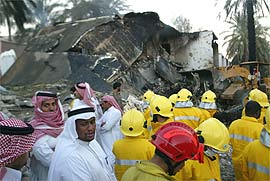
On Sunday November 9th, suicide bombers apparently disguised as Saudi policemen
struck a diplomatic housing compound in Riyadh, the capital, killing at least 17
people. Almost all the dead were from neighbouring Muslim countries, including
Lebanon, Syria and Egypt.
 Al-Qaeda has already been fingered as the likeliest suspect. Richard
Armitage, America's deputy secretary of state, who is visiting Riyadh, said he
believes Osama bin Laden's terror group was behind the attacks. Saudi diplomats
agree. The weekend attack is certainly reminiscent of suicide bombings against
an expatriate housing complex six months ago in Riyadh, which killed 35 people.
Those attacks were also blamed on al-Qaeda. Al-Qaeda has already been fingered as the likeliest suspect. Richard
Armitage, America's deputy secretary of state, who is visiting Riyadh, said he
believes Osama bin Laden's terror group was behind the attacks. Saudi diplomats
agree. The weekend attack is certainly reminiscent of suicide bombings against
an expatriate housing complex six months ago in Riyadh, which killed 35 people.
Those attacks were also blamed on al-Qaeda.
Why would Mr bin Laden's lot be targeting fellow Muslims from
neighbouring countries? Some have speculated that the bombers believed more
Americans lived in the complex, but this seems weak: al-Qaeda usually chooses
its targets with care. More likely is that the attacks are part of an effort to
topple the Saudi government, as Mr Armitage also said.
Mr bin Laden, himself an exiled Saudi, has often railed against the
government's cosy relationship with America—and specifically the presence of
American troops on Saudi soil. The American bases in Saudi Arabia, which once
housed nearly 5,000 troops, closed down after this spring's Iraq war (the bases
had been mostly used to patrol the no-fly zone over Iraq, which became
irrelevant after Saddam Hussein was ousted). But this apparently failed to
mollify al-Qaeda. The terror group would like nothing better than to sow chaos
in a country that neighbours Iraq and serves as America’s biggest supplier of
crude oil. On this view, killing visiting Arabs, including children (and during
the Muslim holy month of Ramadan) could show the impotence of the Saudi regime.
It could just as well backfire, by rousing sentiment against al-Qaeda in places
like Egypt and the Palestinian territories, whose people have in the past shown
some sympathy with the terror group's anti-American objectives—not to mention in
Saudi Arabia itself.
Ironically, al-Qaeda and America appear to share the same near-term goal: to
force change on the ruling Saudi princes. But they favour entirely different
outcomes, of course. Last week, Mr Bush, in a sweeping speech, laid out a vision
for democracy taking root in Arab countries. Unlike Syria and Iran (which have
long been on Washington’s blacklist), Saudi Arabia was not explicitly
criticised. But Mr Bush implicitly rebuked the kingdom, whose repressive
political life is dominated by its 5,000 princes. America would also like to see
the influence of Wahhabism, the strict Islamic strain propagated by the ruling
family, diminished.
Already some reforms are occurring, albeit slowly. Crown Prince Abdullah, the
de facto ruler, recently agreed to televise meetings of the country's national
assembly and to hold local elections in 2004. The country's open battle against
terrorism is itself a change. Even after the September 11th attacks on
America—in which most of the 19 hijackers were Saudi nationals—the kingdom was
loath to admit that it had a terrorism problem. Some officials initially
disputed that Saudis were involved in September 11th, and blamed foreigners for
bombings in Saudi Arabia in 2000 and 2001. But the suicide attacks six months
ago in Riyadh horrified ordinary Saudis and forced the regime to face up to the
presence of home-grown terrorism. Since then, Saudi police have devoted a good
deal of energy to rooting out militants; there have been several bloody
shoot-outs in Riyadh. Arab countries whose citizens were killed in Sunday’s
bombings, and America too, would like to see still more
progress.
|