|
Home>News Center>Most Popular | |
|
|
|
|
|
|
|
|
|
|
||||||||||||||||||||||||||||||||||||||||||||||||||||||||||||||||||||||||||||||||||||||||||||||||||||||||||||||||||||||||||||||||||
|
|
Big black hole rips up star, then eats the crumbs
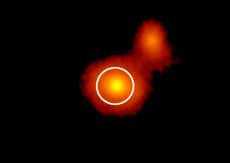
A big black hole ripped apart a sun-like star, gobbled a bit of it and flung the rest out into the cosmic neighborhood in an act of celestial gluttony caught by two orbiting observatories, scientists said on Wednesday. The doomed star probably went off-course and into the supermassive black hole's path after a close encounter with another star, according to astronomers using NASA's Chandra X-ray Observatory and the European Space Agency's XMM-Newton X-ray Observatory. As the star approached the heart of a galaxy some 700 million light-years from Earth, the black hole lurking there stretched the star and ultimately tore it into bits. A light-year is about 6 trillion miles, the distance light travels in a year.
"Stars can survive being stretched a small amount ... but this star was stretched beyond its breaking point," said Stefanie Komossa, leader of the international team of researchers who detected the event. "This unlucky star just wandered into the wrong neighborhood," Komossa said in a statement. Aside from the sheer violence of the event, astronomers believe this is strong evidence to support a long-held theory that black holes are capable of pulling in cosmic bodies, stretching them until they break and then consuming them. "This is one of the Holy Grails of astronomy," Alex Filippenko, a professor at the University of California-Berkeley, said at a briefing at NASA headquarters. COSMIC X-RAYS Astronomers have had evidence since the 1960s that some galaxies emit extremely strong electromagnetic radiation, thought to be spawned by a swirl of material being sucked into each galaxy's central black hole, Filippenko said.
However, the Chandra and XMM-Newton observatories look at the cosmos by tracking X-rays, which means that they can peer through the cosmic gas and dust to detect things that optical telescopes cannot see. These two observatories indicated that the outburst was caused when gas from the ripped-up star was heated millions of degrees as part of it was pulled into the black hole. Some fraction of the star -- more than 1 percent, less than 25 percent -- was drawn into the black hole, while the rest of it was dispersed into the surrounding galaxy, the astronomers said at the briefing. The force that dragged the star to its death is an extreme example of what is known as tidal disruption, the same kind of gravitational pull that the moon exerts on big bodies of water on Earth. Tidal disruption of a star probably happens about once every 10,000 years in a typical galaxy, the scientists said. And a star that wanders close to a black hole is not necessarily dismembered and partially eaten, they said. Some could be swallowed whole, while others might be forced to spin exponentially faster than their normal rotation rate. This happened far from Earth in the constellation Virgo, but could have implications for our Milky Way, which like most galaxies harbors a big black hole in its heart.
However, our sun lies fairly far from the galactic center, some 25,000 light-years away, and recent surveys indicate that there are no stars close enough to the Milky Way's black hole to be dragged into its maw. "None of the stars that we currently see at the center of our galaxy is in immediate danger of being swallowed," Filippenko said.
|
|
|
|
|
|||||||||||||||||||||||||||||||||||||||||||||||||||||||||||||||||||||||||||||||||||||||||||||||||||||||||||||||||||||||||||||||
|
|
|
|
||||||||||||||||||||||||||||||||||||||||||||||||||||||||||||||||||||||||||||||||||||||||||||||||||||||||||||||||||||||||||||||||||