Startup's innovation makes live streaming a reality
Updated: 2016-11-24 08:01
By Chai Hua in Shenzhen(HK Edition)
|
|||||||


While virtual reality (VR) goggles are taking the main stage in the spotlighted VR industry, entrepreneur Cai Shuhuan has chosen a different path.
Competition of VR headset devices is already very fierce, Cai says, so he co-founded Shenzhen KanDao Technology Co Ltd in January this year to focus on developing VR cameras.
Shanghai-based market research firm Canalys predicts that vendors will ship 6.3 million VR headsets worldwide this year, of which 40 percent will head to China.
Canalys analyst Jason Low believes content is one of the key factors to beating the competition, but the main barrier is that most production in the market now requires complex post-processing.

The Shenzhen-based startup says it has countered this hurdle by cutting post-production time by at least half - even supporting live streaming.
The company invented a professional 3D VR camera called "Obsidian" that comes bundled with advanced video-editing software. The tech world is certainly taking notice, as earlier this month, the camera won the "Best of Innovation Honoree" award in the digital imaging product category at the 2017 Consumer Electronics Show in Las Vegas.
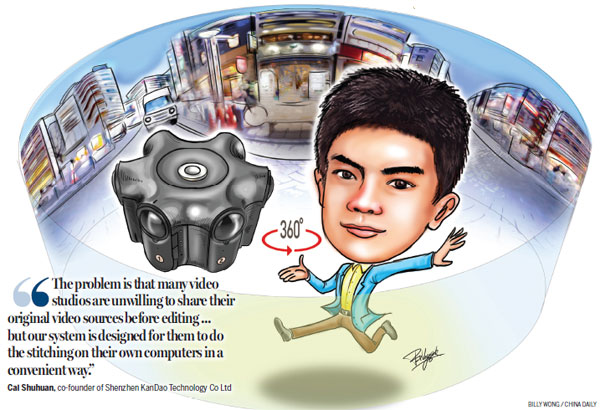
The camera consists of six fisheye lenses around a palm-sized plate, but it's not simply a combination of multiple cameras, Cai says, noting the difficulty in making these cameras record video simultaneously.
After shooting, users can connect the camera to a computer by USB just like a normal camera, and it will then transmit six videos to an editing system that recognizes and stitches them into one panoramic video.
Some VR video makers had previously stitched videos together manually frame-by-frame, which requires lots of time, but Cai says their system can do it automatically, seamlessly and quickly.
He says based on optical flow technology, the company's stitching code can edit one frame per second, compared to Nokia's OZO VR camera - their targeted competitor - which needs two seconds to edit one frame.
There are about 30 frames in each second of a video, so it can process a one-minute video in half an hour.
Social media giant Facebook released a stitching code in May that needs a similar post-production time, but users have to upload the video to its cloud and then Facebook will process it for them.
"The problem is that many video studios are unwilling to share their original video sources before editing," he points out, "but our system is designed for them to do the stitching on their own computers in a convenient way".
Video studios and professional video creators are their major target market, Cai says, and he believes there are about 100,000 to 200,000 potential users in China. These include those providing content to traditional online video platforms and also some new fields such as wedding ceremony shooting, e-commerce stores and tourism promotion.
He's confident that Obsidian's picture quality is leading the industry and even outperforms Kolor, a startup renowned for image stitching technology. Last year, Kolor was acquired by US action camera manufacturer GoPro Inc, which has also launched its own VR camera.
The company has already trialed live streaming for national football and basketball games, as well as recording concerts with its 3D VR camera.
KanDao aims to sell about 5,000 cameras priced at 35,000 to 50,000 yuan ($5,075 to $7,250) each by the end of 2017.
However, Low from Canalys says the VR industry faces a "chicken and egg" situation.
"Without good hardware and a large enough user base, content creators will not invest fully into VR, while users are not attracted without high quality content," he says.
Cai admits the low customer base resembles a bottleneck, but he is optimistic that video platforms and makers have now been forced into action instead of adopting a wait-and-see approach as it did earlier.
The entrepreneur believes "the wheel has started spinning" because competition in the traditional video industry has become so fierce that they have to find new opportunities to attract users.
Smartphone manufacturers are also vigorously promoting the VR experience to the mass market by distributing low-priced or even free VR glasses, Cai says.
The startup has so far received about 60 million yuan in investments from an individual investor, Guangdong Alpha Animation and Culture Co Ltd and Sky Light Holdings Ltd - a Hong Kong-based, listed digital camera manufacturer.
Cai says the team is made up of about 45 software and hardware experts from Hong Kong and Shenzhen, with 90 percent of them involved in research.
grace@chinadailyhk.com
(HK Edition 11/24/2016 page8)