New filial law sparks debate
|
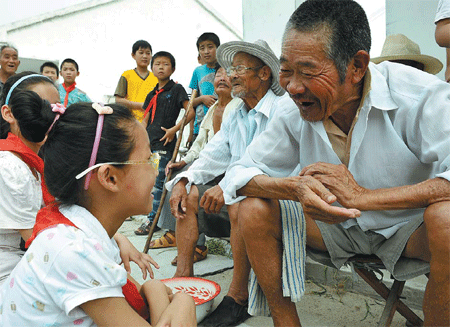
A student from Wangji Primary School in Jiangsu province chats with an elderly man on Sunday. More than thirty students visited the home for the elderly as part of the "filial morality comes first" program. According to a law on protecting the rights and interests of the elderly, which came into effect on Monday, family members should care about the psychological needs of their older relatives, and should visit them or send greetings on a regular basis. Hong Xing / for China Daily |
An amended law that requires children to regularly visit their aging parents has been welcomed by many, but some said it will be just symbolic.
Family members should care about the psychological needs of their older relatives, and should visit them or send greetings on a regular basis, according to the law on protecting the rights and interests of the elderly, which came into effect on Monday.
The law was passed to protect the lawful rights and interests of parents aged 60 and older, and to carry on the Chinese virtue of filial piety, according to the law.
To highlight the implementation of the law, a court in Wuxi, Jiangsu province, held a public hearing on Monday and passed judgement that the two defendants must visit their aging mother at least once every two months after both failed to provide support to the 77-year-old.
Filial piety, considered a key virtue of traditional Chinese culture, generally means respect for one's parents and ancestors, including being good to one's parents and fulfilling one's duty to take care of them.
The law also states that China will cope with an aging population as part of its long-term national strategy, and will improve social security for old people.
"It is a great policy and I am very happy to see the government release such a policy to encourage children to fulfill their obligations to their parents," said Huang Kesheng, a 20-year-old student at the University of International Business and Economics.
Some people, however, doubt whether the law can be applied effectively.
"The policy may be good, but I think it is difficult to carry out," said a security guard for Yinghua Hotel in Beijing, surnamed Shen. "As a temporary worker I seldom have holidays, and I even have to work on Labor Day and National Day."
Shen, who is from the neighboring Hebei province, said he is only able to go home to see his parents twice a year, as he cannot always get leave from his employer.
Yuan Xin, a professor of population studies at Nankai University in Tianjin, supported the law but also highlighted the difficulty of putting it into force.
"In China, traditionally the responsibility of taking care of the elderly lies in family units. As a good traditional virtue, it should not be abandoned," he said.
Parents whose children live apart from them and fail to visit regularly can ask for mediation or file a lawsuit, according to the law.
The law didn't give an exact definition of how often children should go back to see their elders, however, and lacks mandatory force, Yuan said.
"It is primarily aimed at urging all of society to pay more attention to elders," he said.
A major challenge facing the country in taking care of its elderly comes from the rapidly aging society, Yuan said.
The number of elderly parents living alone is increasing fast, while the number of traditional families with several generations living together has decreased dramatically, he said.
In 2010, an 83-year-old man in Beijing filed a lawsuit against his six children for failing to take care of him. The man said he was not short of money but he was very lonely.
Yuan said, "Despite improvements in social security for the old, the social security system still lags behind the needs of the old."
The number of people aged 60 or older in China reached 185 million by the end of 2011, accounting for 13.7 percent of the population, and that number will exceed 200 million this year, according to the Ministry of Civil Affairs. That age group will number 480 million in 2050, Yuan said.
"Compared with some other countries, where the government takes almost all responsibility to take care of the old, China's aging population is developing much faster and the number of elderly people is too big, which means it is impossible to totally rely on the government to care for all the elderly," Yuan said.
Family members, society and the elderly themselves must work together to cope with the challenges that come with the aging population, Yuan said.
Jiang Mengyun contributed to this story.