WWII pilots tell stories
|
Bill Behrns (right), 95, a former US Army Air Force fighter pilot during World War II, speaks on Aug 20 in his study in Stockton, California. Roy Dillon, 92, flew a C-46 transport plane over the Himalayas' famous "Hump". Lia Zhu / China Daily |
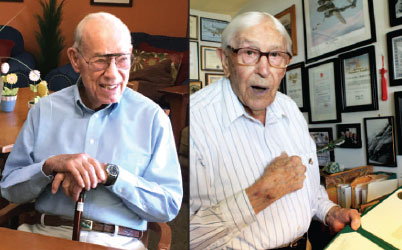
Bill Behrns looks like any other elderly man sitting on the couch with a walker beside him until you see the old medals and photos of him and his fellow P-38 fighters on the walls of his study.
The 95-year-old Behrns was one of the original 32 US Army Air Force pilots sent to the China-Burma-India Theatre (CBI) during World War II to battle the Japanese Air Force. Of the 32 pilots assigned to fly with the 459th Fighter Squadron, only four returned home at war's end.
Behrns' squadron had 25 P-38s, and they were often outnumbered by the Japanese, who had 500 pilots.
"The odds are very bad," Behrns, still in good health, said at his house in Stockton, California. "Twenty-eight of us were killed. They never could come home."
Behrns was born and raised on a ranch outside Stockton. He was drafted and assigned to the Army Air Corps cadet program, and then became a member of the Class of 43F.
During his 18-month service in CBI, he went on 100 missions and shot down three Japanese planes. He was awarded three Distinguished Flying Crosses and three Air Medals and more than four aerial victories.
His award certificate describes one of the missions on April 29, 1944: "Lieutenant Behrns destroyed one enemy fighter at the short range of 75 yards and as two more enemy fighters attempted an attack on him from above and behind, he was able skillfully to elude them."
Behrns also was badly shot. Six times he returned to base with an inoperable engine from enemy gunfire. Once he was shot down and had to survive in the Burmese jungle before being rescued. "The Chinese watched out for me," he said.
Behrns, who worked in retail and real estate after the war, considers himself lucky: "They honored me, but I did nothing special. I'm honored to be where I was, and I'm happy they chose me to be one of the 32 to represent the US."
In Angels Camp, not far from Behrns' residence, lives "Hump" pilot Roy Dillon, 92.
Dillon served from December 1944 to January 1946 in the CBI to fly the infamous Hump, an air route over the Himalayan Mountains used by Allied military transport aircraft to resupply the Chinese war effort.
"I often think of the war, almost every day," Dillon said at his residence. He was sent to India in December 1944 with 14 hours of flying time.
"The weather was always terrible. It was pretty bad most of the year," Dillon recalled. "And the C-46 in service was not thoroughly tested. In three months, 31 of them exploded in air because of oil leakage. It was called a 'flying coffin.' "
Due to the aircraft's poor maintenance, pilot inexperience and terrible weather, 135 airplanes crashed in two years, and 136 crewmen were killed, he said.
"I was very respectful of the Hump," said Dillon. "The terrain was treacherous, and storms also were part of the game."
But the good side of flying the Hump was that the Japanese couldn't make it at night or in wicked weather, he said. "At night, you couldn't see anything. But you knew there were no Japanese."
The C-46 was a large, twin-engine transport aircraft with 2,000 horsepower, and it was always loaded to maximize cargo volume. When one engine was lost over the Hump, the pilots would have to crash-land or parachute from 20,000 feet up, Dillon said.
"We all had such terrifying moments," he said.
After 600 hours, he was eligible to return home but elected to stay, flying 120 more hours over the Hump. In January 1946, he got on a ship and sailed from India to Seattle.
Once back home, he earned a DVM degree at the University of California, Davis, and practiced veterinary medicine until his retirement.
He was awarded a Distinguished Air Cross for 600 hours of service and an Air Medal for 720 hours.
Luo Linquan, Chinese consul general in San Francisco, visited Behrns and Dillon on Aug 20 and presented each man with a certificate of recognition for "heroic deeds and meritorious contributions during the war".
"My part was minimal," Dillon said. "If I did anything, I consider it a privilege, not an honor, to be able to do what I did."
liazhu@chinadailyusa.com