Modern life intrudes on salt tradition
|
A miner carves out blocks of salt from the Danakil Depression in Afar, Ethiopia. Technology and the opening of the area to investment and tourism are threatening the traditional way of life.Zacharias Abubeker / Afp |
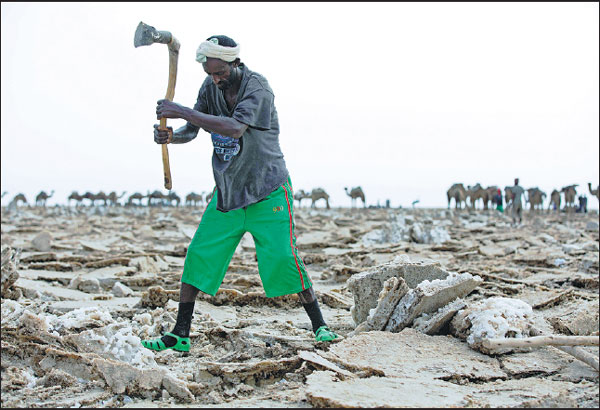
LAKE ASALE, Ethiopia - Every morning, hundreds of men converge on a dry lake bed in a remote corner of Ethiopia, where they cleave the ground open with handaxes to extract salt, just as their fathers and grandfathers once did.
They toil under the gaze of a caravan of camels who will carry their salt bricks to market, in a trek that historians estimate has gone on since the 6th century.
But with the Ethiopian government opening the isolated northern region to investors and tourists by cutting new roads through surrounding mountains, the laborers, traders and caravan drivers that make up the industry say their traditional way of life could soon be lost.
"If it continues like this, it will stop our work," miner Musa Idris said as he stood on the cracked earth that fringes Lake Asale, where the miners work amid temperatures that can reach 50 C, making it one of the world's hottest places.
Salt mining was once so vital to the economy of the depression that the seven-kilogramme chunks of salt Idris and his colleagues hack from the ground were used as currency.
While the trade is still important, it is no longer the only game in town.
Restaurants and hotels have sprung up in the area, also known as the Danakil depression, to cater to tourists who come from across the globe to visit the uniquely desolate landscape formed by the intersection of three tectonic plates.
The region has also attracted foreign firms that want to mine potash and send it to Asia.
The presence of salt in the area has not escaped the attention of mining companies.
A handful of kilometers away from where Idris and his colleagues gather, an Ethiopian company has built a plant that sucks water from the lake into evaporation ponds, creating salt the miners say is of a better quality but costs more than the square blocks they mine from the lake bed.
"The traditional way is quite different from ours. That one takes more toil and time," evaporation plant manager Maheri Asgedew said of the manual way of mining.
Perhaps no development has impacted the traditional salt industry like the new roads.
Ethiopia is Africa's second most populous country and one of the continent's best-performing economies, with growth reaching nearly 10 percent in 2015.
The government has made projects such as dams and road-building a priority as part of its strategy to end the poverty that afflicts around one in three of its citizens.
Getting the salt-laden camels from Lake Asale to the nearest city Mekele used to be a four-day trek down rock-strewn gullies.
Now, the caravans terminate in Berhale, the region's main salt trading outpost which road builders connected to Mekele by tarmac about five years ago.
The journey takes only three days, an improvement that some of the camel drivers and labourers who help offload the salt bricks have welcomed, but which others worry is a sign that technology will soon put them all out of business.
"We have no water and sometimes we eat bad food," said Musa, whose daily pay of 500 birr ($22) affords him a house in Hamed Ela, a ramshackle settlement of huts near the salt fields.
"If technology comes and changes it, it would be better."
But others embrace the traditional way. For them, it's simply the family business.
"We see this as our farmland, so we don't have anything else but this," miner Indris Ibrahim said. "My children and grandchildren will hopefully mine in this area."