 Children
naturally wanted to know where Santa Claus actually came from. Where
did he live, when he wasn't delivering presents? Those questions
gave rise to the legend that Santa Claus lived at the North Pole,
where his Christmas-gift workshop was also located. Children
naturally wanted to know where Santa Claus actually came from. Where
did he live, when he wasn't delivering presents? Those questions
gave rise to the legend that Santa Claus lived at the North Pole,
where his Christmas-gift workshop was also located.
In looking for the historical roots, one discovers that Santa
Claus, as we know him, is a combination of many different legends
and mythical creatures.
The basis for the Christian-era Santa Claus is Bishop Nicholas of
Smyrna (Izmir), in what is now Turkey. Nicholas lived in the 4th
century A.D. He was very rich, generous, and loving toward children.
Often he gave joy to poor children by throwing gifts in through
their windows.
The Orthodox Church later raised St. Nicholas, miracle worker, to
a position of great esteem. It was in his honor that Russia's oldest
church, for example, was built. For its part, the Roman Catholic
Church honored Nicholas as one who helped children and the poor. St.
Nicholas became the patron saint of children and seafarers. His name
day is December 6th.
In the Protestant areas of central and northern Germany, St.
Nicholas later became known as der Weinachtsmann. In England he came
to be called Father Christmas. St. Nicholas made his way to the
United States with Dutch immigrants in the 17th century.
As early as 1773 the name appeared in the American press as "St.
A Claus," but it was the popular author Washington Irving who gave
Americans their first detailed information about the Dutch version
of Saint Nicholas. In his History of New York, published in 1809
under the pseudonym Diedrich Knickerbocker, Irving described the
arrival of the saint on horseback each Eve of Saint Nicholas.
This Dutch-American Saint Nick achieved his fully Americanized
form in 1823 in the poem A Visit From Saint Nicholas more commonly
known as The Night Before Christmas by writer Clement Clarke Moore.
Moore included such details as the names of the reindeer; Santa
Claus's laughs, winks, and nods.
The American image of Santa Claus was further elaborated by
illustrator Thomas Nast, who depicted a rotund Santa for Christmas
issues of Harper's magazine from the 1860s to the 1880s. Nast added
such details as Santa's workshop at the North Pole and Santa's list
of the good and bad children of the world. In the first Nast
illustration, Santa was delivering Christmas gifts to soldiers
fighting in the Civil War. The cartoon, entitled "Santa Claus in
Camp" appeared in Harper's Weekly on January 3, 1863.
A human-sized version of Santa Claus, rather than the elf of
Moore's poem, was depicted in a series of illustrations created by
Haddom Sundblom for Coca-Cola advertisements introduced in 1931. In
modern versions of the Santa Claus legend, only his toyshop workers
are elves.
An advertising writer named Robert May, invented Rudolph, the
ninth reindeer, with a red and shiny nose, while working on a
catalog for the Montgomery Ward Company in 1939.
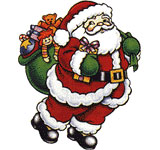
Today's Santa Claus, in his white beard, red jacket and
pompom-topped cap, would sally forth on the night before Christmas
in his sleigh, pulled by eight reindeer, and climb down chimneys to
leave his gifts in stockings children set out on the fireplace's
mantelpiece.
|
|
note:
|
mythical creatures: 神話人物
Orthodox Church: 東正教
patron saint: 守護神
seafarer: 航海家
name day:
命名日
(以其名字命名的圣徒的節(jié)日)
Protestant: 新教徒
press: 新聞
wink: 眨眼
depict: 描寫
rotund: 胖乎乎的
illustration: 插圖
elf: 侏儒
toyshop: 玩具店
sally forth: 出發(fā)
mantelpiece: 壁爐架
| |


