
 Comments()
  Print
Print  Mail
Mail  Large Medium Small
 |
|
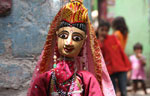
Chen takes a picture with local musicians during a performance in India. |
In the mid 1960s, the government of Guinea, which has a friendly relationship with China, asked China to help reform their traditional instruments. Chen took up the job. In his experiment with the percussion, plucked and blown instruments of Guinea, he discovered a landscape totally different from the Western music world.
"In my research and work of instrument reform, I came to realize the rich music traditions of non-Western countries. They have their own aesthetics and should not be judged according to Western standards," Chen says.
Related: China meets Australia through images
It was at that time that Chen began to develop his interest in world music, but the closed state of China during that period made his research very hard. He tried to make use of every possible opportunity to learn more about world music. For example, a Soviet Union-made documentary film about Peruvian soprano Yma Sumac greatly impressed him about the unique Peruvian culture, and helped him to sustain his interest in Peruvian music.
After the "cultural revolution" (1966-76), Chen began to teach world music at the Central Conservatory. With the opening-up of China, more international musicians and experts visited China. In 1983, world renowned Indian musician Ravi Shankar visited China. Chen accompanied Shankar for most of his stay in China and learned many things about Indian music from him.
In 1989 when Chen had the chance to study in India for a year, he visited Shankar in his home. They remain friends till this day, and last month Chen received the Taichi Traditional Music Award in Beijing on behalf of Shankar, who, at 92, couldn't make it to the award ceremony.
Chen not only watched many performances in India, but also learned to play Indian instruments such as the tabla. He was deeply drawn into the rich world of Indian music, especially its ornamentation and improvisation.
"In India, traditional music is very much alive, and almost intact after a century of colonization," Chen says. "There is a lot for us to learn from India in terms of preserving traditional music."
Despite his age, Chen still teaches graduate and PhD students at the Central Conservatory of Music. All his students have to do field research in another country, sometimes up to one year.
Chen is now preparing for the sixth conference of the World Music Society of China, which will be held in Pu'er, Yunnan province, next year. As Yunnan is close to Southeast Asia, the conference will focus on the musical exchange between China and Southeast Asia.
"I have lost too much time during and before the 'cultural revolution'. Now I have to continue to work to make up for it," says Chen, who does not plan to retire.
Contact the writer at muqian@chinadaily.com.cn.



Copyright 1995 - 2010 . All rights reserved. The content (including but not limited to text, photo, multimedia information, etc) published in this site belongs to China Daily Information Co (CDIC). Without written authorization from CDIC, such content shall not be republished or used in any form. Note: Browsers with 1024*768 or higher resolution are suggested for this site.
License for publishing multimedia online 0108263 Registration Number: 20100000002731