
 Comments()
  Print
Print  Mail
Mail  Large Medium Small
|
Publications |
|
|
|
The Lion and the Jewel |
|
|
|
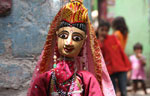
Death and the King's Horseman |
|
|
|
Ake, the Years of Childhood |
Soyinka also makes Chinese writers and critics like Xu pay attention to Nigeria's literary tradition and strength, including Booker Prize winner Ben Okri's The Famished Road, and Orange Prize winner Chimamanda Ngozi Adichie's Half of a Yellow Sun.
Soyinka says he tends to affiliate more with the bigger African cultural identity — "Africanity" as he calls it — than the Nigerian one, according to the Southern Weekly.
"Soyinka was a pioneer. He and J.P. Clark more or less laid the foundations of what we know now as modern African theater in English," says Osofisan, who is also a notable Nigerian writer.
To Osofisan, Soyinka is not only an inspiration but also a teacher who's always willing to help out.
"He is one of the best people you can know, very caring and compassionate and always full of laughter," Osofisan says.
Soyinka has long been associated with political activities that overthrew British colonialism and brought down dictators. Being imprisoned and expelled at times, he has a rich life experience that he presents in his dramas and poems.
Soyinka has also been teaching in British and US universities, including Yale, Harvard and Oxford.
"In my class of comparative literature, I expand the reading material from colonial literature to Asian literature, which includes Chinese and Japanese literary works," he says.
"Politics is one part of my writing," Soyinka says. "But political fashion changes, literature remains."
Osofisan recalls when Soyinka was in exile after the civil war he was a graduate student in Paris, at the Sorbonne. "In fact, it was in his car that I rode to Paris from London."
The battling writer had been in prison for months, with no pen or paper at hand.
"I made inks and pens myself, saved toilet paper for writing," Soyinka told the Southern Weekly.
"Then I found the most economical and material-saving way was to write poetry, in minimal writing," he says. "All the other surging ideas had to wait."
Soyinka won the Nobel in 1986 for being a writer "who in a wide cultural perspective and with poetic overtones fashions the drama of existence".
He says he noticed the huge national response after Chinese writer Mo Yan won the same prize in October.
"We had massive celebrations back in my country, too, when I won," he says. "But the prize has too much mystique."
"Of course the money of the prize is important for a poor writer like me," he says, adding he used the money to build a house as a retreat for other writers and expand his stock of wine.
Soyinka has also enjoyed interacting with Japan's Nobel laureate Kenzaburo Oe, a longtime friend. Being longtime friends, Oe applies Soyinka’s characters, dialogues and images to his own works in new ways.
"It's the special way two great minds exchange," Oe's Chinese translator Xu Jinlong says.
Contact the writer at meijia@chinadaily.com.cn.



Copyright 1995 - 2010 . All rights reserved. The content (including but not limited to text, photo, multimedia information, etc) published in this site belongs to China Daily Information Co (CDIC). Without written authorization from CDIC, such content shall not be republished or used in any form. Note: Browsers with 1024*768 or higher resolution are suggested for this site.
License for publishing multimedia online 0108263 Registration Number: 20100000002731