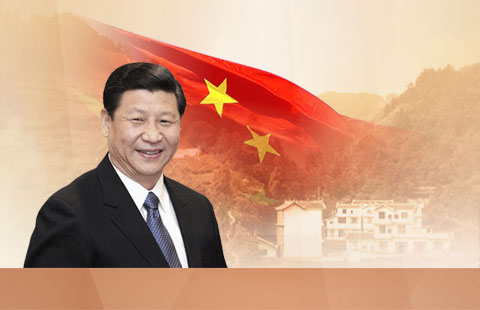
Delivering his keynote speech at the World Economic Forum in Davos, Switzerland, on Tuesday, President Xi Jinping reiterated China's commitment to opening-up and its firm opposition to trade protectionism.
Speaking in front of political and business leaders from around the world, he said it is not globalization that should be blamed for the sluggish recovery of the global economy.
The unimpressive economic recovery and the widening gap between the haves and have-nots as well as the South and the North, as Xi pointed out, are the result of insufficient momentum for growth, ineffective global governance and unbalanced development.
His comments come at a time when economic globalization is fraught with uncertainties, or as some pessimists argue, is in reverse, following Donald Trump's victory in the US presidential election and the United Kingdom's "all-out" departure from the European Union, including its single market.
However, calling it the demise of globalization, which features increasing interdependence among all economies thanks to the free flow of commodities, capital, personnel, and information, is going a bit too far.
Brexit and a worrisome new US government are indeed not good news, but they are not likely to turn the tide of globalization.
The expansion of global trade is both a result of economic globalization and an engine of it. The global value chains forged over decades of cross-border exchanges have greatly changed how the world economy works: The economic well-being of all countries are more intertwined than ever.
International mechanisms are contributing to globalization, too. The Trade Facilitation Agreement, inked after the ninth World Trade Organization Ministerial Conference on the Indonesian island of Bali in 2013, includes provisions pledging to fight all forms of protectionism. It is estimated that the implementation of the Bali package, the first multilateral agreement to be ratified since the WTO's birth, could increase global trading by about $1 trillion per year.
The unanimous ratification of the Paris Agreement on climate change marks a historic step in the efforts to deal with global climate change. Under the deal, all signatories are obliged to step up their cooperation to contain the rise of the global average temperature and curb greenhouse gas emissions.
China, one of the main beneficiaries of globalization, is now a torchbearer for better global governance. While hosting the G20 Hangzhou summit last year, it made clear its commitment to globalization and proposed solutions to the problems. Not only has Beijing proposed inclusive concepts such as a community of shared destiny for all humankind and the Free Trade Area of the Asia-Pacific, it is also making progress in realizing them.
The success of the Belt and Road Initiative, the Asian Infrastructure Investment Bank, and the BRICS New Development Bank, speak volumes for China's development, which as Xi said at Davos, is "an opportunity for the world". The nation welcomes other countries to share the opportunities of its development.
Countries aspiring to make a difference should adopt an innovation-driven approach to improve old growth models, and cooperate on reciprocal, inclusive programs for shared development. With the bright prospect of more technological breakthroughs, globalization can remain on the right track.
The author is a researcher at the Institute of European Studies at the Chinese Academy of Social Sciences, and director of the Center for Latin American Studies, Shanghai University.




Copyright 1995 - . All rights reserved. The content (including but not limited to text, photo, multimedia information, etc) published in this site belongs to China Daily Information Co (CDIC). Without written authorization from CDIC, such content shall not be republished or used in any form. Note: Browsers with 1024*768 or higher resolution are suggested for this site.
License for publishing multimedia online 0108263 Registration Number: 130349