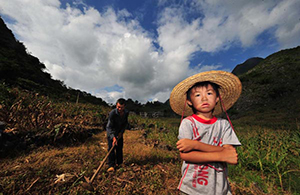
Filial piety, usually taken to mean unconditional love, respect and obedience from children to parents, is often considered a traditional Chinese virtue. Yet every time I visit my hometown, one thing that shocks me is the number of elderly people in the village that seem to be totally ignored by their children.
The 24 Guidelines for Filial Piety, released on Aug 14, were intended to address this problem and encourage children to pay more attention to their parents' needs. And one cannot really argue with suggestions such as children should visit their parents as often as possible and be attentive to their parents' emotional needs
The guidelines were intended to be a modern equivalent of the 24 Exemplary Stories of Filial Piety, collected by Guo Jujing during the Yuan Dynasty (1271-1368), which presents extreme examples of filial piety as role models to be aspired to. One of the stories features Zeng Can, a disciple of Confucius, who feels pain when his mother bites her finger because of her anxiety when a stranger comes to visit during her son's absence. It is a story about empathy instead of telepathy. The story simply wants to show Zeng's compassion for the pains and struggles of his mother. Another story is about the early life of Emperor Shun, a legendary Chinese ruler, who was mistreated by his harsh dad, stepmother and stepbrother. Instead of harboring resentment, he quietly endures and works hard in the fields while the rest of the family idle around. His stoicism moves the gods to help him, and they send elephants to plow the fields, and crows and magpies to pull up the weeds for him. This may seem strange, but I find it to be more inspiring than Cinderella who escapes from similar bad fortune through marriage to a prince.
Guo's paragons of virtue have survived down through the centuries, while the guidelines tailor-made for modern times seem already forgotten.
This is because the new guide is well-intentioned but deeply flawed in its method. Instead of presenting stories to inspire filial piety in children, it tells them specifically what to do; for instance, teaching parents how to use the Internet. Yet in the less-developed areas, computers are hard to come by. In another guideline, it is suggested children express their love for parents verbally. This can be difficult for adult children to do.
Demonstrations of filial respect will naturally vary from family to family. In one family it makes sense to give parents pocket money as the guide suggests. In another, it may be wiser to buy parents things or services they need.



I’ve lived in China for quite a considerable time including my graduate school years, travelled and worked in a few cities and still choose my destination taking into consideration the density of smog or PM2.5 particulate matter in the region.
Copyright 1995 - . All rights reserved. The content (including but not limited to text, photo, multimedia information, etc) published in this site belongs to China Daily Information Co (CDIC). Without written authorization from CDIC, such content shall not be republished or used in any form. Note: Browsers with 1024*768 or higher resolution are suggested for this site.
License for publishing multimedia online 0108263 Registration Number: 130349