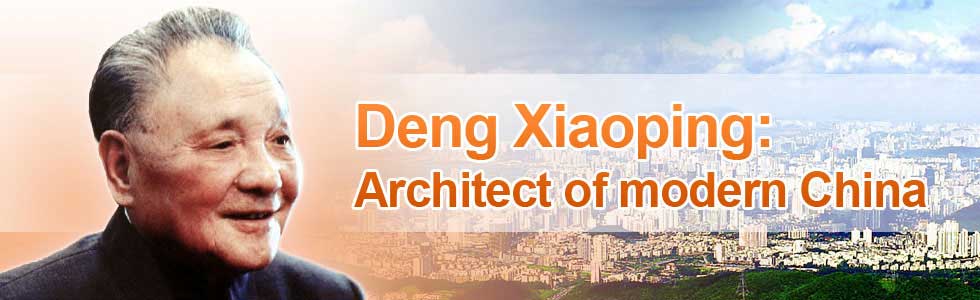
Revisiting Deng and the socialist market economy

The author is a senior research fellow and head of Partnerships & Programmes at the Institute of South Asian Studies, National University of Singapore.
"Opening-up" has been gradual with the authorities carefully taking note of policy repercussions, if any, before enlarging their scope. The calibrated preference is visible even today as China experiments with new generation reforms in latest laboratories like the Shanghai Free Trade Zone.
China's has not been an entirely unblemished story. High economic growth has had its side effects. These include widening of economic and regional disparities and a heavy toll on sustainable indicators through depletion of water resources, and massive carbon emission and pollution.
China's success and the more undesirable consequences of that success have influenced modern development discourse. While China's success in building infrastructure, reducing poverty and upgrading slums have become almost mythical, the income inequality and pollution indices have also become yardsticks in different contexts.
How to explain the social and economic costs of China's growth on the way to building up of socialist market economy?
It is important to remember that the experiment of guiding the market with socialist oversight and outreach is an unprecedented project. Being top-down in order, it is also vulnerable to setbacks dealt by local characteristics. This probably explains why Guangdong province succeeded in creating exemplary special economic zones while Hainan province didn't.
Market forces are genies that once uncorked can produce spectacular results. The qualitative aspects of these results become known much later.
Almost two decades after the launch of reform and opening-up, Chinese authorities responded to widening regional disparities by proposing specific development plans for its relatively underdeveloped western region. But the western region will still take a lot of time and efforts to catch up with the eastern and southern parts of the country. Businesses and markets do not always respond to even the most favorable of incentives, unless they can see enabling conditions, which are far more in China's coastal provinces than its hinterland.
The socialist aspect of the economic policy has helped China take quick action wherever gaps have emerged. On many occasions, the socialist State and its organs have encouraged and helped businesses. But a pro-business outlook is not necessarily pro-market. There are probably sectors and areas where several businesses have prospered because of their ability to use State organs to their advantage.
Nonetheless, these are areas where markets have not matured because of lack of competition. China's socialist market economy continues to experience the tension, but it needs to encourage more competition.
The author is a senior research fellow and head of Partnerships & Programmes at the Institute of South Asian Studies, National University of Singapore.
(China Daily 08/20/2014 page9)

Learn from Deng's diplomacy
Although seventeen years have elapsed since Deng's passing away in 1997, China is still forging ahead in the overall direction of reform and opening-up to the outside world that Deng charted for China after he became the paramount leader at the end of the 1970s. [more]
Revisiting Deng and the socialist market economy
China has come a very long way since Deng Xiaoping articulated his vision of a reformed and modern China in December 1978. More than 35 years after the historical Third Plenum of the 11th Central Committee of the Communist Party of China in December 1978, "socialist market economy" has become a frequently used phrase in modern economic and development literature. [more]

Scholars explore Deng's impact
Ranging from Deng's life and thought to the history of reform in China, the overseas studies of this former Chinese leader have undeniably shed new light on not only his own political, economic, cultural, military, and, diplomatic thought, but also on his important theories including the “One Country, Two Systems” policy that successfully enabled Hong Kong’s smooth return to the Motherland. [more]

Carry on institutional reform
By directing China's reform and opening-up since 1978 and innovating socialism with Chinese characteristics, the late Chinese leader Deng Xiaoping made a breakthrough in improving the institutional building of modern China, leading the country from the rule of man to the rule of law. [more]