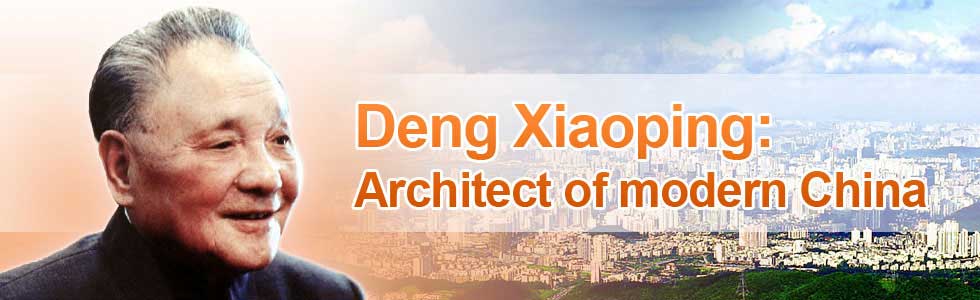
Deng's legacy of "strategic thinking" critical for current China
At the seminar marking late leader Deng Xiaoping's 110th birthday on Wednesday, Chinese President Xi Jinping summarized six aspects of Deng's political legacy, one of which is Deng's strategic thinking.
It is the first time the Chinese leadership mentioned strategic thinking as one of Deng's political legacies. It is not only about the wording, but closely relates to the current situation in which China needs to address various issues by embracing Deng's approach.
Deng and his comrades saved China at a critical time in the country's history, not by small repairs, but with systematic methods and visionary designs.
Deng's reform concerned almost all aspects of the country, from science and technology to ideologies, from industrial powerhouses to the most rural areas.
Deng took all aspects into the greater picture, and made breakthroughs on easier issues at the beginning. With comprehensive and strategic thinking, he led the country on its way to prosperity.
In the new century, the country has always vowed reform, but in many aspects, reforms have yet to reach people's expectations. In health, education, income distribution and many other fields, people are still making complaints.
China began a new round of reforms after the transition of Communist Party and state leadership in late 2012 and early 2013. A package of reform policies have also been announced and some have been implemented.
Like Deng's approach, the current reforms are not simple repairs of current policies.
In a key decision made at the Third Plenary Session of the 18th Central Committee of the Communist Party of China in November last year, a total of 60 missions were clearly laid out. Simple and separate reforms cannot succeed as almost all state issues are interconnected.
At the plenum, the central leadership vowed to strengthen independence of local governments from China's judicial system. Reform of the administrative system will cut governments' power, empowering the market instead. In addition, many changes will be directed toward State-owned Enterprises.
All the reforms involve various departments, levels of governments and interests groups, which require the central authorities to view them in the bigger picture and the political courage to implement.
In this sense, Xi's mentioning of strategic thinking has its practical significance. Xi has in several occasions stressed the importance of top-level design, which was in essence follows Deng's forward-looking strategic thinking.
Reform is never an easy task, especially in a country as big and complicated as China. Reviewing Deng's legacy gives the current Chinese leadership a wise methodology and experience to carry on reform tasks.
Although the situations are different, the essence of Deng's statesmanship will always serve as a lighthouse for which progress can follow.

Learn from Deng's diplomacy
Although seventeen years have elapsed since Deng's passing away in 1997, China is still forging ahead in the overall direction of reform and opening-up to the outside world that Deng charted for China after he became the paramount leader at the end of the 1970s. [more]

Revisiting Deng and the socialist market economy
China has come a very long way since Deng Xiaoping articulated his vision of a reformed and modern China in December 1978. More than 35 years after the historical Third Plenum of the 11th Central Committee of the Communist Party of China in December 1978, "socialist market economy" has become a frequently used phrase in modern economic and development literature. [more]

Scholars explore Deng's impact
Ranging from Deng's life and thought to the history of reform in China, the overseas studies of this former Chinese leader have undeniably shed new light on not only his own political, economic, cultural, military, and, diplomatic thought, but also on his important theories including the “One Country, Two Systems” policy that successfully enabled Hong Kong’s smooth return to the Motherland. [more]

Carry on institutional reform
By directing China's reform and opening-up since 1978 and innovating socialism with Chinese characteristics, the late Chinese leader Deng Xiaoping made a breakthrough in improving the institutional building of modern China, leading the country from the rule of man to the rule of law. [more]