 |
|
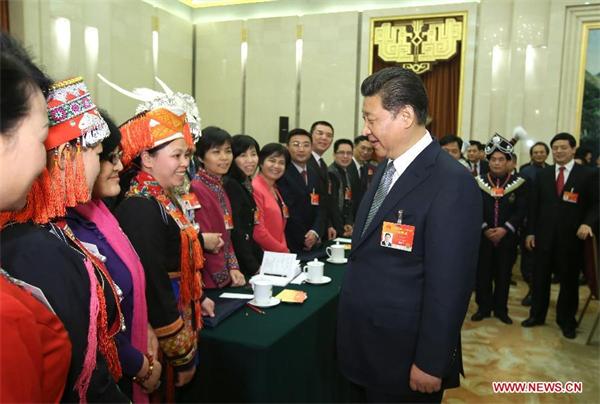
Chinese President Xi Jinping (front R), also general secretary of the Communist Party of China (CPC) Central Committee and chairman of the Central Military Commission, greets female deputies for the International Women's Day at a panel discussion with deputies to the 12th National People's Congress (NPC) from south China's Guangxi Zhuang autonomous region during the third session of the 12th NPC, in Beijing, capital of China, March 8, 2015. [Photo/Xinhua] |
The rule of law and strictly regulating the Party are two of "Four Comprehensives" put forward by the top leader Xi Jinping recently as a blueprint for realizing the rejuvenation of the nation.
A better understanding of the relationship between the rule of law and strictly regulating the Party will help people better understand China's anti-corruption campaign and why it will continue.
Some deem that the ruling Communist Party of China is superior to the rule of law, and the policies and guidelines mapped out by the Party, including its disciplines, are superior to the State's laws. This view conforms to China's decades-long reform and opening-up practices. The Party first drafted the policies and guidelines to push forward reform, and then the law was revised to fit the changes brought about when the reform was developed to a certain stage; which turned the Party's policies into national operative norms.
However, others believe that the Party's disciplines must be within the framework of the Constitution and the law, and they should only exist if they are in line with the law. When they violate the law, they should be abolished.
In fact, the communiqué that focuses on "comprehensively advancing the rule of law", which was passed by the Fourth Plenum of the 18th CPC Central Committee in October last year, resolved this difference.
It clearly states that the regulations of the Party provide the basis for the Party's management, and they guarantee the construction of the country with socialist rule of law. The regulations and disciplines of the Party are more rigid than the State's laws, and they are an essential part of the anti-corruption system and the most basic code of conduct for all Party members.
The anti-corruption system with Chinese characteristics presents the following features.



I’ve lived in China for quite a considerable time including my graduate school years, travelled and worked in a few cities and still choose my destination taking into consideration the density of smog or PM2.5 particulate matter in the region.
Copyright 1995 - . All rights reserved. The content (including but not limited to text, photo, multimedia information, etc) published in this site belongs to China Daily Information Co (CDIC). Without written authorization from CDIC, such content shall not be republished or used in any form. Note: Browsers with 1024*768 or higher resolution are suggested for this site.
License for publishing multimedia online 0108263 Registration Number: 130349