 |
|
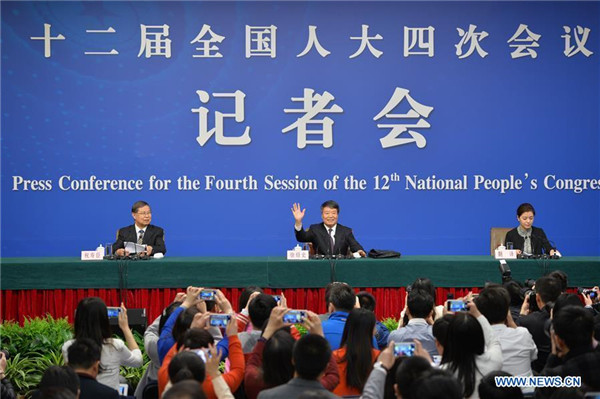
Xu Shaoshi, minister in charge of the National Development and Reform Commission, gives a press conference for the fourth session of China's 12th National People's Congress (NPC) on the country's economic and social development and the draft outline of the 13th Five-Year Plan, in Beijing, capital of China, March 6, 2016. [Xinhua/Li Xin] |
Premier Li Keqiang's daily work schedule during the annual session of the National People's Congress reflects China's changing economic geography.
By noting which provincial delegations he visits, one can tell which provinces the central government expects to lead the transition of the world's second-largest economy.
It is obvious that the central government wants some provinces and places to serve as good examples and new growth leaders. While some others, mostly those suffering more from the old big-smokestack industries and environmental inadequacies, are to be allowed more time for restructuring even as they follow the direction of the growth leaders.
Li's first attendance on Sunday was to the deliberations of the delegation of lawmakers from Shandong, one of the most powerful provincial economies in the Chinese mainland, along with Guangdong and Jiangsu.
Shandong registered an 8 percent growth in GDP in 2015, more than 1 percentage point higher than the national average (6.9 percent), and it plans to target 7.5 to 8 percent growth in 2016, again 1 percentage point higher than the national target range.
On Monday, the premier attended the discussions of deputies from Fujian, an eastern province across from the Taiwan Straits. A province with little industry 40 years ago, Fujian has not only built itself into an industrial powerhouse, reflected in its 9 percent GDP growth in 2015, but also done so with an eye on the local environment. For instance, it enjoys the highest rate of forest coverage among all Chinese provinces.
The premier's choice of delegations reflects the government's strategic sense that distills from China's historic experience in running a large and diverse country.
There are different kinds of regional gaps. Some, if they exist for too long and result in an imbalance in income distribution, will have to be closed. While other gaps, if they reflect different regional approaches to self-improvement, are healthy and can be used to prompt nationwide progress.
At the moment, the very size of its society and its diversity are two important factors that can help China fight its current slowdown.
Such understanding of China's economic geography may also help the country answer many of the questions it faces at the moment-such as how will it manage to stay out of trouble in a time of looming uncertainties in many parts around globe? And how will it continue to grow and remain strong?
Well, as Li would likely reply, by relying on its people and its diversity.
Copyright 1995 - . All rights reserved. The content (including but not limited to text, photo, multimedia information, etc) published in this site belongs to China Daily Information Co (CDIC). Without written authorization from CDIC, such content shall not be republished or used in any form. Note: Browsers with 1024*768 or higher resolution are suggested for this site.
License for publishing multimedia online 0108263 Registration Number: 130349 

