Market economy treatment should be extended to China
 |
|
WANG XIAOYING/CHINA DAILY |
The question of whether the United States and European Union will extend to China the treatment of a market economy has become increasingly prominent as Dec 11 approaches, because this date marks the end of the 15-year period after China's accession to the World Trade Organization.
China's treatment after 15 years of WTO membership and whether or not it is given market economy status are two different issues, but they are essentially the same, because in its foreign trade, whether or not other countries extend China market economy status lie in whether they will use the prices and costs in China as the criteria whenever there is an anti-dumping and anti-subsidy investigation launched against its commodities. If market economy methodologies are used for determining normal value there is no significant difference to it being considered a market economy.
Paragraphs (a) and (d) of Article 15 of the WTO protocol on China's accession explicitly describe such scenarios, and mean that after December, methodologies other than a methodology based on Chinese costs and prices cannot be used for the determination of normal value in anti-dumping investigations concerning goods originating in China.
The Article has four paragraphs: The first covers price and cost comparison methodologies in dumping investigations, the second the calculation of benefit in subsidy investigations, the third with notifications to the WTO, and the fourth addresses the status or nature of China's market.
Paragraph (a) stipulates that: "In determining price comparability under Article VI of the GATT 1994 and the Anti-Dumping Agreement, the importing WTO member shall use either Chinese prices or costs for the industry under investigation or a methodology that is not based on a strict comparison with domestic prices or costs in China based on the following rules: (i) If the producers under investigation can clearly show that market economy conditions prevail in the industry producing the like product with regard to the manufacture, production and sale of that product, the importing WTO member shall use Chinese prices or costs for the industry under investigation in determining price comparability; (ii) the importing WTO member may use a methodology that is not based on a strict comparison with domestic prices or costs in China if the producers under investigation cannot clearly show that market economy conditions prevail in the industry producing the like product with regard to manufacture, production and sale of that product".
Paragraph (d) stipulates that: "Once China has established, under the national law of the importing WTO member, that it is a market economy, the provisions of paragraph (a) shall be terminated provided that the importing member's national law contains market economy criteria as of the date of accession. In any event, the provisions of subparagraph (a)(ii) shall expire 15 years after the date of accession. In addition, should China establish, pursuant to the national law of the importing WTO member, that market economy conditions prevail in a particular industry or sector, the non-market economy provisions of paragraph (a) shall no longer apply to that industry or sector".
These clauses of the WTO protocol indicate that from Jan 1 of next year, after 15 years of China's accession to WTO, other WTO members should not continue to use the "substitute nation" method when conducting an anti-dumping and anti-subsidy probe against China, irrespective of whether or not they recognize China and its individual industries as having market economy status, and only China's prices and costs should be used as reference.
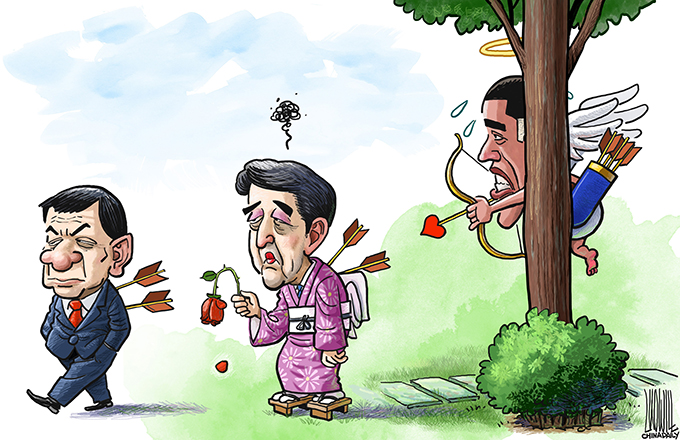
Since the US and European countries signed the WTO protocol at the time of China's accession, they are obliged to fulfill the international commitments they made 15 years ago, although it is up for them to decide whether to recognize China such a status.
There are now strong incentives within both the US and the EU not to fulfill their commitments. In the context of their current account balance of payment continuously worsening, both the US and the EU hope to preserve the "substitute nation" price system. On May 12, the European Parliament overwhelmingly voted against extending China market economy status. Of the 73 anti-dumping measures currently taken by the EU, 56 are targeted at imports from China. European protectionists are citing this as an excuse to deny China its market economy status, so that they can keep Chinese goods outside the door and protect local employment. The sentiment is the same in the US.
As a leading importer, China has means at its disposal to counteract some countries' refusal to give China normal market economy treatment. But China knows that protectionism and trade retaliation are not the best way to resolve trade disputes among countries. So, while the US and the EU should know and weigh the price they may have to pay if they invite proportionate countermeasures from China, the latter is urging the US and EU to extend to it market economy treatment even if they fail to formally grant it the market economy status.
The author is a researcher at the International Trade and Economic Cooperation Institute of the Ministry of Commerce.