Print
Print  Mail
Mail  Large Medium Small
分享按鈕
0
Large Medium Small
分享按鈕
0
|
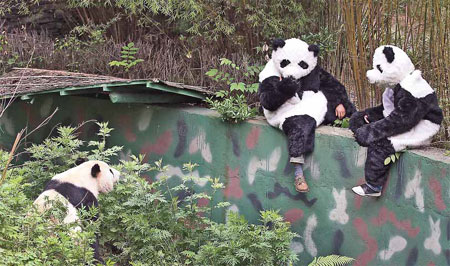
Researchers dressed in panda costumes during a training session at the China Conservation and Research Center for the Giant Panda in Wolong, Sichuan province. Feng Yongbin / China Daily |
The cameras do not always work effectively and can barely detect the pandas when thick leaves cast their shadows across the fields, so researchers fitted Cao Cao with a GPS collar, enabling them to pinpoint her position and sphere of activity. The collar receives satellite signals that record the panda's longitude and altitude at any given moment and allows the researchers to download data from a distance of approximately 500 meters, although sometimes the thick foliage means that they have to approach as close as 100 meters.
The scientists now plan to make a model leopard, cover its body with excrement and urine collected from the zoo and record leopard roars. Eventually, the model will be placed inside the living area and a researcher will hide in a camouflaged watchtower. When Tao Tao passes close to the model, the researcher will activate a remote control to make the fake leopard roar and then observe Tao Tao's reaction. Using this technique, they hope to scare the cub and teach him how to identify and avoid natural enemies.
"As researchers, we are most worried about whether he can make it in the wild," said Zhang, the director of the center. Those concerns were especially acute at the beginning of the training period. Around 10 days after Tao Tao was born, Wolong was battered by a heavy two-day rainstorm. Everyone at the center was wracked with anxiety and a heated debate ensued as the researchers argued over whether to take the cub back to the center.
In the end, Zhang decided to take a risk. "We have to clench our teeth to surmount this barrier," he said. "If we take him back now, we'll have to take him back next time a similar problem crops up. So we have to take a brave step. Even if he dies, he'll be making a sacrifice for the salvation of his own species." To the relief of all the researchers, Tao Tao came through the rainstorm unscathed.
Concerns were again aroused during a heavy snowstorm in February 2011. Some parts of the training area, including the bamboo plantations, were buried in snow a meter deep. At the time, Tao Tao had just learned to walk and the researchers were afraid he would perish in the severe cold. However, their concerns were proved unfounded when they discovered that Cao Cao had trodden a path in the snow so that Tao Tao could follow in her footsteps. Later, the mother protected her offspring by driving a mask palm civet out of their living area.
"Now we have learned the lessons and realize that panda cubs must be steeled through bad weather and tough environment. It's the only way they will learn to adapt to this habitat," said Zhang.
After nearly two years of training, Tao Tao exhibits few differences to wild pandas in terms of food-base selection, searching out sources of water, orientation, evasion of enemies, and social communication, according to Zhang.
On May 3, Tao Tao and his mother were moved to a 240,000-sq-m area higher up in the mountain. By the time the pandas left, the cub already weighed 36 kg. Now, until October, the training schedule will focus on identifying natural enemies and friendly animals. The researchers also plan to buy some wild boar and goats and introduce them into the training area. They will also transfer a small number of pandas to Wolong from Ya'an so that Tao Tao can develop social connections and understand his place within the panda community.
"Our next step will be to form a standardized procedure for wilderness-survival training and establish a training plan with an annual target number," said Zhang. "That way we'll have a steady flow of pandas that fit the criteria to be released into small wild groups, integrate with the local community and breed. After years of hard work, we will finally achieve our goal of protecting the wild pandas, increasing their population and preserving their genetic diversity."
Contact the reporter at jiangxueqing@chinadaily.com.cn
(China Daily 06/08/2012 page1)

In China, most giant pandas live in the mountains of Qinling, Minshan, Qionglai, Daxiangling and Xiaoxiangling.

By the end of 2011, the number of wild giant pandas in the world was about 1,590.
Copyright 1995 - 2010 . All rights reserved. The content (including but not limited to text, photo, multimedia information, etc) published in this site belongs to China Daily Information Co (CDIC). Without written authorization from CDIC, such content shall not be republished or used in any form. Note: Browsers with 1024*768 or higher resolution are suggested for this site.
License for publishing multimedia online 0108263 Registration Number: 20100000002731