国产热热热精品,亚洲视频久久】日韩,三级婷婷在线久久,99人妻精品视频,精品九热人人肉肉在线,AV东京热一区二区,91po在线视频观看,久久激情宗合,青青草黄色手机视频

中國(guó)甘肅網(wǎng)

Mogao Grottoes

Female characters revealed in Mogao Grottoes (Ⅰ)

Updated: 2016-03-11
By Li Xiaoxu ( chinadaily.com.cn )

Female characters revealed in Mogao Grottoes (Ⅰ)

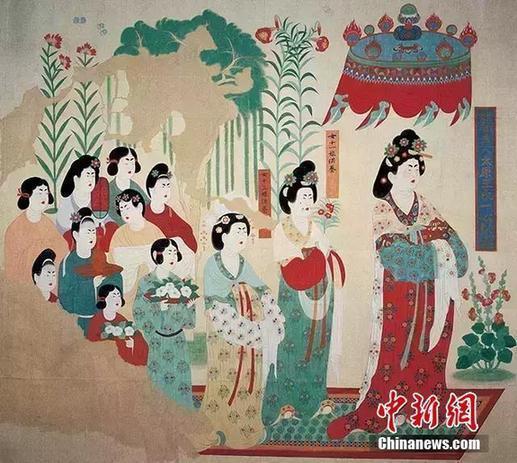
The fresco shows the female benefactors of grottoes during the Tang Dynasty (AD 618-907) at Mogao Grottoes. [Photo/Chinanews.com]

Female Bodhisattvas, benefactresses and several other characters from Mogao Grottoes' classic frescoes were inspired by women in Tang Dynasty, said Dunhuang Research Academy on March 8.

Mogao Grottoes, situated at Dunhuang city in Northwest China's Gansu is a system of 492 temples and is honored as one of the most valuable discoveries of the 20th century.

It has the world's largest and most abundant collection of Buddhist artwork. There are 735 caves accommodating 2,415 colored sculptures and 4.5 square meters of frescoes.

The construction of the Mogao Caves near Dunhuang is generally taken to have begun sometime in the fourth century AD when a Buddhist monk named Le Zun was inspired to build a cave and later other monks joined him. By the Tang Dynasty, the number of caves had reached more than a thousand.

According to the academy, the frescos made in Tang Dynasty (AD 618-907) have the female characters inspired by women at that time, revealing the women's appearance, clothing and status.

For example, many scholars supposed that the prototypes of Apsaras in frescoes are modeled on young noble women such as queens, princesses, wives and daughters of nobility in ancient China.

The historical documents recorded that Apsara was the ideal woman for people in the ancient time, because of her compassion and perfect appearance.

Previous Page 1 2 3 Next Page

  • Lanzhou
  • Chengguan
  • Qilihe
  • Xigu
  • Anning
  • Honggu
  • Yuzhong
  • Gaolan
  • Yongdeng
  • Jiuquan
  • Suzhou
  • Yumen
  • Dunhuang
  • Guazhou
  • Jinta
  • Aksay
  • Subei
  • Tianshui
  • Qinzhou
  • Maiji
  • Qingshui
  • Qin'an
  • Gangu
  • Wushan
  • Zhangjiachuan
  • Wuwei
  • Liangzhou
  • Gulang
  • Minqin
  • Tianzhu
  • Zhangye
  • Ganzhou
  • Shandan
  • Minle
  • Linze
  • Gaotai
  • Sunan
  • Baiyin
  • Baiyin
  • Pingchuan
  • Huining
  • Jingyuan
  • Jingtai
  • Pingliang
  • Kongtong
  • Jingchuan
  • Lingtai
  • Chongxin
  • Huating
  • Zhuanglang
  • Jingning
  • Qingyang
  • Xifeng
  • Zhengning
  • Huachi
  • Heshui
  • Ningxian
  • Qingcheng
  • Zhenyuan
  • Huanxian
  • Dingxi
  • Anding
  • Tongwei
  • Longxi
  • Zhangxian
  • Weiyuan
  • Minxian
  • Lintao
  • Longnan
  • Wudu
  • Chengxian
  • Liangdang
  • Huixian
  • Xihe
  • Lixian
  • Kangxian
  • Wenxian
  • Dangchang
  • Linxia
  • Linxia
  • Kangle
  • Guanghe
  • Yongjing
  • Hezheng
  • Dongxiang
  • Jishishan
  • Gannan
  • Hezuo
  • Zhugqu
  • Jone
  • Lintan
  • Tewo
  • Xiahe
  • Luqu
  • Maqu

Copyright @ 2013 China Daily

All Rights Reserved
Sponsored by Gansu Provincial Government
Powered by China Daily
乌鲁木齐县| 康乐县| 驻马店市| 盐池县| 儋州市| 林口县| 金华市| 沙雅县| 民县| 玛曲县| 宁德市| 五原县| 丰都县| 绥棱县| 德阳市| 六安市| 平凉市| 禹州市| 弥勒县| 陵川县| 平顶山市| 南投市| 鄂尔多斯市| 都匀市| 长治县| 东平县| 蓬安县| 乌恰县| 呼玛县| 利川市| 大邑县| 隆德县| 天祝| 鄂托克旗| 来凤县| 什邡市| 镇坪县| 吉木萨尔县| 多伦县| 新绛县| 壶关县|