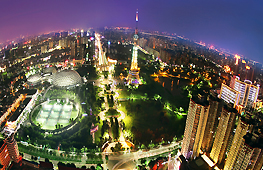
Anhui province


Population: 70,829,000 (2018)
Area: 140,100 square kilometers
Geography
Anhui province lies in the monsoonal area of East China. The demarcation line of the Qinling Mountain Range-Huaihe River runs through the northern part of Anhui. Being the sub-center of the Yangtze River Delta urban agglomeration, Anhui province is one of the country's smallest provinces, stretching across approximately 570 kilometers from north to south.
Climate
Anhui differs in climate from north to south. The north is more temperate and has more clear-cut seasons. January temperatures average around ?1 to 2 C north of the Huaihe River, and 0 to 3 C south of the river. In July temperatures average 27 C or above. The rainy season occurs in June and July.
Compared with the climate in other parts of China, Anhui is characterized by concentrated rain in the hot season and a remarkable continental monsoonal climate. In addition, Anhui has a mild climate, abundant sunshine, distinctive seasons (warm spring, hot summer, cool fall and cold winter) and an obvious monsoon.
History
Anhui, one of the most important cradles of Chinese civilization, was set up in the sixth year of the Kangxi reign of the Qing Dynasty (1667). The name of the province comes from the combination of the first character of the names of two prefectures – Anqing and Huizhou. As there is Wan Mountain and there was an ancient nation named Wan in the province during the Spring and Autumn Period (722-481 BC), Anhui is also called Wan (皖) for short.
Culture
Anhui spans many geographical and cultural regions. The northern, flatter parts of the province, along the Huaihe River and further north, are most like neighboring provinces like Henan and Shandong. In contrast, the southern, hilly parts of the province are more similar in culture and dialect to other southern, hilly provinces, like Zhejiang and Jiangxi. Anhui boasts traditional calligraphy products, including Xuan paper and Hui ink, which are arguably considered of the best quality.
Economy
In the first quarter of 2019, Anhui's provincial GDP totaled 706.57 billion yuan ($102.96 billion), up 7.7 percent compared with that of the previous year. The added value of the first, second and tertiary sectors were 35.2 billion yuan, 343.23 billion yuan, and 328.14 billion yuan, up 2.8 percent, 8.7 percent and 7.1 percent.
The provincial import and export volume climbed by 6.9 percent to $16.09 billion, including an export volume of $8.81 billion, up 14.8 percent year-on-year.
Administrative divisions
The province consists of 16 cities – Hefei, Huaibei, Bozhou, Suzhou, Bengbu, Fuyang, Huainan, Chuzhou, Lu'an, Ma'anshan, Wuhu, Xuancheng, Tongling, Chizhou, Anqing, and Huangshan – and seven county-level cities, 54 counties and 44 districts.