China's digital economy surges 18.9%, drives growth
( Xinhua )
BEIJING — China's booming digital economy had been serving as a major engine for the country's economic growth.
China's digital economy surged 18.9 percent in 2016 to 22.6 trillion yuan ($3.35 trillion), according to a white paper issued by China Academy of Information and Communications Technology (CAICT), Ministry of Industry and Information Technology (MIIT).
The expansion was much faster than that of China's overall economy, which grew 6.7 percent in 2016.
Digital economy accounted for 30.3 percent of China's total gross domestic product (GDP) over the year, said the white paper. Taking its spillover effect into account, digital economy contributed 69.9 percent to the GDP in 2016, it added.
Digital economy, also known as the internet economy, is based on digital computing technologies, comprising new business models such as e-commerce, cloud computing and payment services.
Technology is functioning as a driver of revenue and enabler of new business models for many Chinese companies, including China e-commerce giants Alibaba and JD.com.
China's digital economy grew significantly higher than the overall economy, becoming a major engine of growth, said the paper.
CAICT expects China's digital economy to be valued at 32 trillion yuan and account for 35 percent of the whole GDP by 2020, before taking up over half of the country's GDP by 2030, according to the white paper.
China has made a point of promoting digital economy as part of its measures to upgrade the economy, and the central and local governments had identified digital economy as "major development strategy."
At the G20 Hangzhou Summit in 2016, China put digital economy high on the agenda, making it part of the G20 Blueprint on Innovative Growth for the first time.
In March this year, Report on the Work of the Government called for more efforts to deepen the development of "Internet Plus" and accelerate the growth of digital economy. This is the first time that "digital economy" was referred to in such a report.
And the central government is to formulate and issue a strategic plan for promoting digital economy, according to the State Council executive meeting held on July 12.
Local governments had also geared up for digital economy, with Guizhou, Jiangsu, and Anhui among others, having made provincial-level plans to make their economy more digitalized.
For example, southwestern Guizhou aims to make added value created by digital economy grow 20 percent annually and carve up at least 30 percent of the province's GDP by 2020.
Digital economy has become an area where China's economic transformation and industrial upgrading can achieve major breakthrough, said MIIT Minister Miao Wei in April.
Miao pointed to smart manufacturing, industrial internet, sharing economy, and the digitalization of traditional industries as areas that should be boosted.
The development of China's digital economy, however, is imbalanced, with the service sector adopting the digital economy more extensively than the primary and secondary industries, said Lu Chuncong, president of Communications Policy and Economics Research Institute, CAICT.
Regulation of market access does not suit the development of digital economy, said Lu, calling for establishing a mechanism of negative list where all market players can enter digital economy on an equal footing.
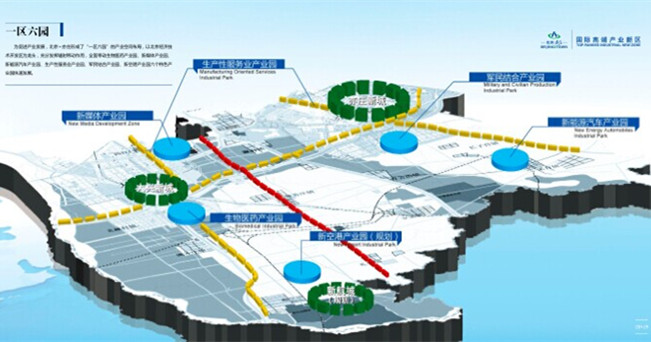 The Area with Six Parks
 Global Top 500