WASHINGTON - Maybe there will be a bigger party when the population hits 400
million. Save the date: 2043. America's official population passed the 300
million mark Tuesday, fueled by a growing number of immigrants and their
children.
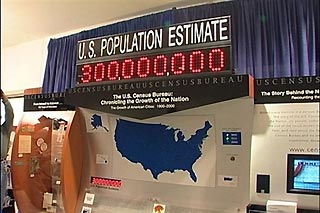 The moment, recorded at 7:46 a.m. EDT, passed with little fanfare,
perhaps dampened by a divisive debate over illegal immigration and the fact that
many experts think the population had already hit the 300 million mark months
ago.
The moment, recorded at 7:46 a.m. EDT, passed with little fanfare,
perhaps dampened by a divisive debate over illegal immigration and the fact that
many experts think the population had already hit the 300 million mark months
ago.
There were no fireworks or government-sponsored celebrations. Just a written
statement from
President Bush near the end of the work day, welcoming
the milestone as "further proof that the American Dream remains as bright and
hopeful as ever."
"It's a couple of weeks before an election when illegal immigration is a
high-profile issue, and they don't want to make a big deal out of it," said
William Frey, a demographer at the Brookings Institution, a Washington think
tank.
It's been 39 years since the U.S. population reached 200 million. Since then,
about 55 percent of the growth has come from immigrants, their children and
their grandchildren, according to a recent report by the Pew Hispanic Center, a
nonpartisan research organization.
In other words, if the U.S. had cut off all immigration since 1967, the
population would be about 245 million - and a lot less diverse, said
Jeffrey Passel, a senior demographer at the center.
"We've had much more Asian and Latino immigration than white and black," said
Passel, the study's author. "That has led to the racial and ethnic diversity
that we have today."
When the population hit 200 million in 1967, more than 80 percent of
Americans were white and less than 5 percent were Hispanic. Less than 1 percent
were Asian.
Today, Hispanics make up nearly 15 percent of the population and Asians about
5 percent. White non-Hispanics account for about 67 percent, blacks a little
more than 13 percent.
By 2043, white non-Hispanics are expected to be a little more than half.
That's the year the population is projected to hit 400 million, though the
numbers could change significantly depending on immigration and birth rates.
In 1967, President Johnson held a news conference at the
Commerce
Department to mark the 200 million milestone. He hailed the country's past and
talked about the challenges ahead. Life magazine dispatched a cadre of
photographers to find a baby born at the exact moment, anointing a boy born in
Atlanta as the 200 millionth American.
This year, there's a good chance the 300 millionth American walked across the
border from Mexico months ago.
Commerce Secretary
Carlos Gutierrez, himself an immigrant from Cuba,
said the Bush administration isn't playing down the milestone, though no public
events were scheduled.
"I would hate to think that we are going to be low key about this," said
Gutierrez, whose department oversees the
Census Bureau. "I would hope
that we make a big deal about it."
| 1 | 2 |  |
