Schools review safety after Va. massacre
(AP)Updated: 2007-04-19 08:38
OLUMBIA, Mo. - Cell phone text messages. Loudspeakers on towers. Cameras that detect suspicious activity. Colleges and universities are considering these and other measures in the aftermath of the Virginia Tech massacre, seeking to improve how they get the word out about emergencies to thousands of students across sprawling campuses.
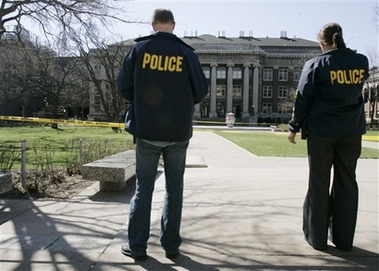 Police officers keep guard in a cordoned off area of the University of Minnesota as eight buildings on campus were evacuated after a bomb threat Wednesday, April 18, 2007 in Minneapolis. [AP]  |
"You're going to see a nationwide re-evaluation of how to respond to incidents like this," said Jeff Newton, police chief at the University of Toledo.
Chuck Green, director of public safety at the University of Iowa, said school officials were discussing a new outdoor warning system just a day before the Blacksburg shootings. The technology would allow for live voice as well as prerecorded messaging.
"We'd like the option to hit one button to reach large numbers of people at one time," he said.
Virginia Tech officials did not send an e-mail warning about a gunman on campus until two hours after the first slayings, drawing criticism that they waited too long and relied on e-mail accounts that students often ignore.
"Would a blast e-mail have been the most effective tool in notifying people of Monday's events?" asked John Holden, a spokesman for DePaul University in Chicago. "Some of the coverage I'm seeing suggests that old-fashioned emergency alarms or broadcast announcements would probably have been more effective."
At many schools, officials want to send text messages to cell phones and digital devices as a faster, more reliable alternative to e-mail.
"We have to find a way to get to students," said Terry Robb, who is overseeing security changes at the University of Missouri.
The University of Memphis plans to build a system that will act as a schoolwide intercom. Scheduled to be in place by this fall, the system will consist of speakers mounted on three or four tall poles.
At Johns Hopkins University, officials installed more than 100 "smart" cameras after two off-campus slayings. The cameras are linked to computers that detect suspicious situations, such as someone climbing a fence or falling down, and alert not only campus security but also Baltimore city police.
Using text messages would require students to provide personal cell phone numbers ¡ª an intrusion that many colleges and universities have until now been reluctant to pursue, said Howard Udell, chief executive officer of Saf-T-Net AlertNow, a Raleigh, N.C., company that specializes in campus security.
Cell phone numbers "have to be as vital as your Social Security number," he said. "I don't think it's been a priority."
The Virginia Tech massacre could bring about widespread safety reforms at colleges and universities, much as the Columbine shootings in Colorado led to security improvements at primary and secondary schools, Udell said.
"We're going to use lessons learned from Virginia Tech's tragedy as much as we can," said Auburn University spokeswoman Deedie Dowdle.
Text-message alert systems are already in place at some schools, including Penn State University, which started its program in the fall. The system has transmitted 20 emergency messages since its start, ranging from traffic closures to weather-related cancellations or delays.
At the University of Minnesota, 101 of the university's 270 buildings have electronic access devices. A control center can selectively lock and unlock doors, send emergency e-mail and phone messages, and trigger audio tones and messages. Video cameras monitor 871 locations around the university and radio networks link the university with police.
Despite the widespread safety reviews, nothing short of a total lockdown would ensure the safety of campus communities, said Maj. Frank Knight, assistant chief of police at East Carolina University in Greenville, N.C.
"Stopping an individual with a weapon from getting on campus is nearly impossible," he said. "We can't ever guarantee the security of the campus 100 percent."
At Birmingham-Southern, a small private school in Alabama, campus police also use less sophisticated methods: cars equipped with public-address systems and even runners carrying messages.
Campus Police Chief Randy Youngblood said officers used car-mounted loudspeakers during storms in recent years, and the system has been effective on the small campus.
|
||
|
||
|
|