Iran: OPEC won't increase oil output
(AP)Updated: 2007-06-11 20:14
KUALA LUMPUR, Malaysia - The Organization of Petroleum Exporting Countries has no plans to release more oil into the market ahead of its next policy meeting in September, Iran's oil minister said Monday.
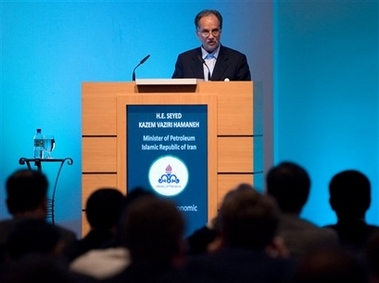 Iranian Minister of Petroleum Kazem Vaziri Hamaneh delivers his keynote address at the 12th Asia Oil and Gas Conference 'A Shared Future' in Kuala Lumpur, Malaysia, Monday, June 11, 2007. [AP] |
There is adequate crude oil in the market and commercial oil inventories are at a high level, Iranian Minister of Petroleum Kazem Vaziri Hamaneh told reporters on the sideline of a regional oil and gas conference here.
"There is sufficient crude oil in the market, there is no shortage of crude oil," he said when asked if OPEC should raise supplies to the market to ease high oil prices.
"Commercial oil stocks are at a very high level, at a comfortable level. The reason for the price hike is not the level of the crude oil stocks. It's not that problem."
Asked if crude oil prices, currently hovering at $65 a barrel, could surge to $80 a barrel, Hamaneh said: "We cannot predict what will happen to prices."
In July 2006, oil prices hit a record high of $78.40 a barrel. In Asian electronic trading Monday on the New York Mercantile Exchange, light sweet crude for July delivery was trading at $64.94 a barrel.
Hamaneh said Iran also has no concrete or immediate plans to supply crude to China's strategic oil reserves, although he added that "we have discussed that issue."
With China and India expected to become two major oil consumers in the next 20 years, he said Iran is keen to build energy cooperation in Asia.
The government is finalizing five joint-venture refinery projects in the region in China, Indonesia, Malaysia, Singapore and Syria, which will have total capacity of 1.1 million barrels a day, he said without elaborating except to say Iran will provide the crude.
Separately at the conference, Malaysian Prime Minister Abdullah Ahmad Badawi said the world has sufficient oil and gas reserves "to meet global needs for many decades to come" - and the key challenge is gaining access to them.
Global proven reserves are estimated at about 1.2 trillion barrels of oil, which could last 40 years at current production rate, while natural gas reserves could last 70 years, said Abdullah, whose country is a leading global exporter of liquefied natural gas and significant regional oil producer.
James Mulva, chairman and chief executive of U.S. third largest oil company ConocoPhillips, warned it may be tough to meet global oil demand, which is projected to increase by 40 percent by 2030 or 120 million barrels a day.
Natural gas is expected to grow even faster by 66 percent by 2030, he told the conference.
But multinational companies currently have access to only 7 percent of the world's oil and gas resources, and to another 25 percent through partnerships with national oil firms, leaving "two-thirds of the world's resources off limits to us," he said.
Mulva said the International Energy Agency has estimated that $8.2 trillion investment is required for global oil and gas development through 2030.
Asia-Pacific alone requires $1 trillion for the period, he said.
|
||
|
||
|
|