More Bush-Congress court fights likely
(AP)Updated: 2007-08-06 13:57
WASHINGTON - A court decision concluding that federal agents went overboard in searching a congressman's office almost certainly presages more legal showdowns over the Bush administration's fierce battle with Congress for control of information.
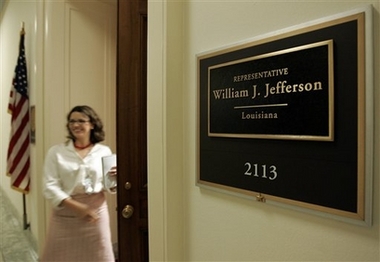 A reporter walks out of the Capitol Hill office of Rep. William Jefferson, D-La., in this June 4, 2007 file photo. [AP]  |
"Most people feel this has been the most aggressive executive branch, maybe in the history of the country, in terms of asserting its executive authority," said Carl Tobias, a constitutional law professor at the University of Richmond in Virginia.
The stakes have risen in recent months as the Democratic-controlled Congress began contempt proceedings against some of Bush's top aides and suggested a perjury investigation of his attorney general.
At least some clashes appear headed for court, where judges again will wrestle with a question central to the republic's founding: Where to strike the balance between the executive and legislative branches' powers so that one does not ride roughshod over the other?
"I think you'll find the courts are going to become more involved," Sen. Ben Cardin, D-Md., a lawyer who is on the Senate Judiciary Committee, said in an interview after the court decision Friday. "This administration has a well-deserved reputation for arrogance. I think they just try to believe that they are not susceptible to checks and balances."
Bush and his aides reject such claims. They say it is essential that a president receive candid advice from advisers not subject to congressional subpoenas. They have tried to restore vital executive branch powers they feel eroded during the Watergate and Vietnam War eras.
Many congressional Republicans support them, saying Democratic-led inquiries too often overreach. "The legislative branch has focused on investigations, subpoenas, condemnations, attacks, calls for impeachment, calls for contempt," said Sen. Kit Bond, R-Mo.
But even Bush loyalists such as Bond say the administration's penchant for secrecy goes too far in some areas.
Bond, the Senate Intelligence Committee's top Republican, long has urged the administration to release a CIA inspector general's report on the Sept. 11 attacks. "Just get it out there and get it over with," he said.
Bush drew the greatest bipartisan condemnation, not surprisingly, when he backed investigative tactics that included an FBI night raid in 2006 of Rep. William Jefferson's offices on Capitol Hill.
The U.S. Court of Appeals for the District of Columbia Circuit ruled Friday that the Justice Department violated congressional independence in going through a large number of the Louisiana Democrat's files. Jefferson subsequently was charged with bribery.
Top Republicans, including then-Speaker Dennis Hastert of Illinois, denounced the raid and hailed Friday's ruling. "I felt very strongly that the separation of powers were breached when that happened," Hastert said.
Republicans in Congress tend to back Bush more strongly on issues that do not hit so close to home. But many Democrats and outside analysts say the administration is virtually spoiling for legal fights to re-examine where the executive-legislative balance of power lies.
Democrats hooted when Vice President Dick Cheney recently asserted that neither Congress nor the executive branch could probe his actions.
Perhaps the action most likely to trigger a showdown over Bush's repeated claims of executive privilege was last month's House committee vote to launch contempt charges against former White House counsel Harriet Miers. Bush has asserted executive privilege in refusing to let her testify in Congress' probe of the firing of several federal prosecutors.
Legal scholars say executive privilege is an imprecise term asserted by several presidents but never fully settled by the courts. The Miers case, some say, could be a good test of how to balance a president's need for private advice against Congress's need to oversee executive branch actions that might include political abuses.
"There will be more courts," Senate Judiciary Committee Chairman Patrick Leahy, D-Vt., said Friday. "This administration takes a position that no administration has, certainly since Marbury v. Madison, that somehow they are above the law," he said, referring to the 1803 Supreme Court decision establishing judicial reviews.
Bruce Fein, a Washington lawyer who was an associate deputy attorney general in the Reagan administration, fears Congress is not fighting hard enough to parry Bush's claims of executive privilege.
"The Bush administration is close to reducing Congress to wallpaper, when it comes to oversight, if Congress does not respond" more forcefully, he said.
Republicans, he added, may come to regret the precedents that Bush is asserting.
"I tell my Republican friends that Hillary Clinton will be the president some day," Fein said. "They just don't get it."
|
|
|
||
|
||
|
|