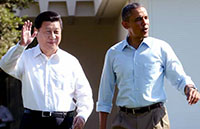
Chinese President Xi Jinping's visit to the US in September may well mark a historical turning point in US-China relations. As I reflect back on my 45-year association with China, I cannot help but admire China's historically unprecedented development, and the steadfastness with which the governments of China and the US have worked together to overcome adversities and maintain an engaged and mutually beneficial relationship over four-plus decades. This relationship has not only benefited the two countries, but indeed the entire world.
Since President Richard Nixon's history making visit to China in 1972, the US and China have been steadfast in maintaining a strategic embrace throughout a series of high and low points in the relationship. That relationship, born in each country's search for a counter to Soviet expansion, bloomed through most of the 1970s as trade and cultural exchanges increasingly buttressed Beijing's and Washington's geopolitical calculations. By mid-1978 secret discussions conducted through each country's liaison offices had reached the point where establishment of full diplomatic relations became a real possibility, poised to correct a nearly 30-year hiatus. As a Foreign Service Officer assigned at the time to the State Department's China Desk, I was privileged to be part of the historic shift underway. (Note: for an excellent depiction of the events of 1978-79, I recommend Fu Hongxing's biographic film of Deng Xiaoping's 1979 visit to the US - Mr. Deng Goes to Washington.)
The rapid expansion of our relationship that followed normalization on January 1, 1979, included the establishment of embassies in each other's capital and up to five consulates general in each other's country. In early 1980 I was sent to help open and staff the US Consulate General in Shanghai. While relations "on the ground" then were sometimes tendentious, we and our Chinese counterparts ploughed ahead in setting the parameters for how this new relationship would be implemented in the years ahead. Our efforts received a giant boost in August 1982 when the two sides signed the third joint communique, which placed limits on future US arms sales to Taiwan.
By 1990 and with the collapse of the Soviet Union, the basis for Sino-US relations began to shift away from geostrategic considerations and more toward the two countries' growing economic interdependence. After China's accession to the World Trade Organization in December 2001, it quickly rose to become a global trade power and a principal economic partner of the US As a resident of the State of Washington I can attest to the importance of this partnership to our state's economy. More than 40 percent of our state's jobs depend on international trade and China is far and away our most important trade partner. Both our imports from, and exports to, China benefit our economy and create and sustain jobs.
But, the realignment of the basis for our relationship away from geostrategic and toward economic considerations has not been trouble free, nor is it complete. Over the past 35 years, China's economy has grown from about 10 percent of the size of the US economy to nearly 2/3 the size. It has also become the world's largest trading economy and is now an integral component of global economic and political systems as well. As such China is now more focused on its national goals and less hesitant about pursuing them.
On the economic side, China's efforts to rebalance its economy with more emphasis on domestic consumption as the main driver of growth and less on exports, infrastructure and fixed asset investment have not yet achieved significant results. At the same time, China's economic growth is slowing considerably as shrinking exports and real estate development drive down industrial production. Although it is too early to say that China's economic reforms are failing or that China is reverting to more reliance on historical growth drivers, steel exports and infrastructure investment are both up significantly in the first half of this year.
On the security side, a host of issues have emerged over the last three years or so that challenge the bilateral consensus on the need for engagement.
Thus, the meeting next month between Presidents Xi and Obama takes on additional importance. The two governments have maintained high level dialog through summit meetings and the ministerial Security and Economic Dialog conferences. Such contact has been instrumental in harmonizing the goals of an established global power with those of a rising power. The summit in Washington presents major challenges, but also a unique opportunity to firm up the basis of what is certainly the most important bilateral relationship in the world today. When historians 100 and more years from now look back on this time, they will no doubt hold the nature of Sino-US relations as the key determinant on whether the 21st Century was one of peace and prosperity, or of conflict and poverty. Let us hope the two presidents have the imagination and political will to set a course toward peace and prosperity.
The author is the former president of the Washington State China Relations Council and currently serving as a mentor in the Albers School of Business and Economics at Seattle University.
(China Daily USA 09/23/2015 page12)
Copyright 1995 - . All rights reserved. The content (including but not limited to text, photo, multimedia information, etc) published in this site belongs to China Daily Information Co (CDIC). Without written authorization from CDIC, such content shall not be republished or used in any form. Note: Browsers with 1024*768 or higher resolution are suggested for this site.
License for publishing multimedia online 0108263 Registration Number: 130349