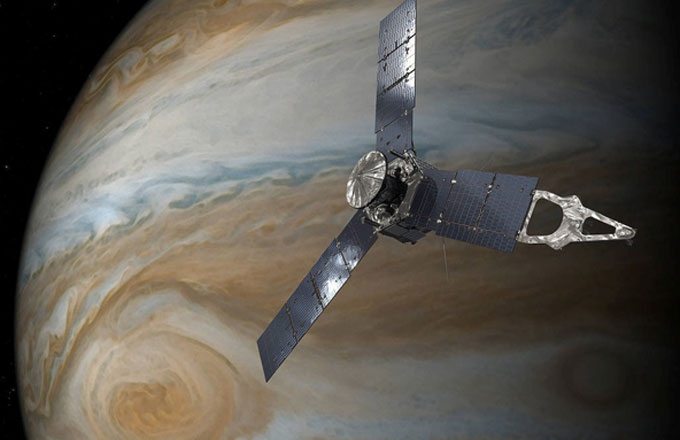
Probe peers into Jupiter's Great Red Spot


 |
|
NASA's Juno spacecraft in orbit above Jupiter's Great Red Spot is seen in this undated handout illustration obtained by Reuters July 11, 2017. [Photo/Agencies] |
The Juno probe logged its close encounter with Jupiter's most distinctive feature on Monday evening as it passed about 9,000 kilometers above the clouds of the mammoth cyclone.
Jupiter's Great Spot is a 16,000-km-wide storm monitored since 1830 and possibly existing for more than 350 years.
But it will take days for readings captured by Juno's array of cameras and other instruments to be delivered to scientists at the Jet Propulsion Laboratory in Pasadena, California, and much longer still for the data to be analyzed.
Scientists hope the exercise will help unlock such mysteries as what forces are driving the storm, how long it has existed, how deeply it penetrates the planet's lower atmosphere and why it appears to be gradually dissipating.
Astronomers also believe a greater understanding of the Great Red Spot may yield clues to the structure, mechanics and formation of Jupiter as a whole.
"This is a storm bigger than the entire Earth. It's been there for hundreds of years. We want to know what makes it tick," said Steve Levin, the lead project scientist for the Juno mission at JPL.
Levin said the storm is believed to be powered by energy oozing from Jupiter's interior combined with rotation of the planet, but the precise inner workings are unknown.
Some of the most valuable data from Monday's flyby is expected to come from an instrument designed to peer into the red spot at six different depths, Levin said.
The churning cyclone ranks as the largest known storm in the solar system with winds clocked at hundreds of kilometers an hour around its outer edges. It appears as a deep, red orb surrounded by layers of pale yellow, orange and white.
Once wide enough to swallow three Earth-sized planets, the famed Jovian weather system has been shrinking for the past 100 years and may eventually disappear altogether.
Still, the spot remains the most prominent characteristic of the solar system's largest planet, a gargantuan ball of gas - mostly hydrogen and helium - 11 times the diameter of Earth with more than twice as much mass as all the other planets combined.
Reuters - Xinhua