|
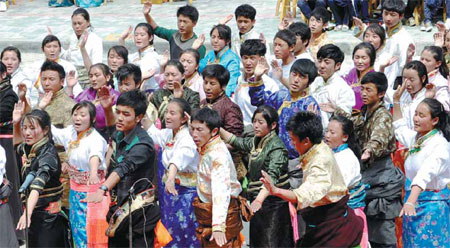
Students at No 1 Minzu High School of Hainan Tibetan autonomous prefecture were debating at the annual debating conference held at the school in May 2012. Provided to China Daily |
The revival and honoring of an ancient form of debate is bringing change to the classrooms, as Yang Yang reports from Hainan Tibetan autonomous prefecture in Qinghai province.
At 5:20 on a freezing December afternoon, 80 grade-two students gathered in the open air in front of a school building. They split into two groups: students on one side sat on the ground, while the others stood facing them. The groups then split up into small debating teams, with one student standing and a couple of their peers sitting on the ground. When the standing student asked a series of questions, those sitting on the ground attempted to provide answers as concisely as possible.
As the debates continued, the students, who spoke rapidly in cadenced Tibetan, grew increasingly excited. The questioners raised themselves on one leg and took a step forward, clapping their hands to warn their audiences that it was time to provide answers. The antics made some of the students laugh and their faces glowed red, as if unaffected by the cold. At the end of the hour-long session, as the shadows lengthened and the air grew cooler, the students returned to their classrooms.
Welcome to the world of Hetuvidya, or Buddhist Logic.
Hetuvidya has been part of Tibetan Buddhism for about 1,000 years, and is regarded as a highly effective tool for logical analysis. However, the debating tradition, an essential element of the daily routine of Tibetan monks as they study Buddhist scriptures, has only in recent years attracted the attention of mainstream scholars. Now, a number of schools and universities in northeastern China are honoring the tradition of reasoned debate by emphasizing its value as a cornerstone of philosophical enquiry.
Look, listen and learn
"Practical debates are part of the Hetuvidya study course. Every week, all grade one and two students have two Hetuvidya classes - one concerns theory and the other is a practical debate on everything they've learned or want to discuss," said Lubumkyab, vice-principal of No 1 Minzu High School in Hainan Tibetan autonomous prefecture, Qinghai province.
"We've been offering this course since 2005, when we were trying to identify the best way of carrying out the government's essential-qualities-oriented schooling policy," he said.
Does one plus one definitely equal two? Which is primary and which is secondary, matter or ideas? We all agree that the sun rises in the east, but what is "east"? While many philosophical schools have discussed these elementary, but difficult, questions, the discussion of abstract thought is not a common practice in Chinese high schools.
Because of the enormous pressure exerted by the gaokao (the national college entrance examination) which falls in June every year, high school students in China are encouraged to sit quietly, listen to their teachers and memorize philosophical concepts and theories, such as Marx's ideas on historical materialism. Debate is rarely seen as part of the process.
Related:An end to long-distance learning

Copyright 1995 - . All rights reserved. The content (including but not limited to text, photo, multimedia information, etc) published in this site belongs to China Daily Information Co (CDIC). Without written authorization from CDIC, such content shall not be republished or used in any form. Note: Browsers with 1024*768 or higher resolution are suggested for this site.
License for publishing multimedia online 0108263 Registration Number: 130349