|
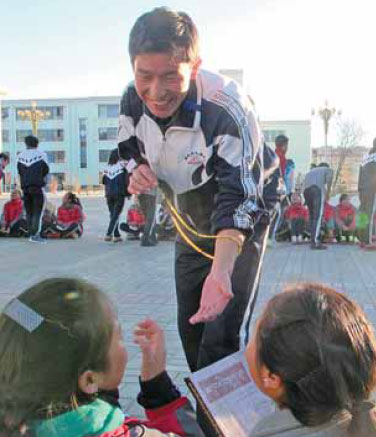
Students debating at No 1 Minzu High School. The boy challenges the girls to answer his question. Yang Yang / China Daily |
There are exceptions to every rule, however, and No 1 Minzu High School is one of them. Half of the students are taught in Tibetan, the other half in Mandarin Chinese. However, no matter which language is used, Hetuvidya courses are mainly restricted to grade one and two students. The gaokao is the top priority for grade-three students, and so only the best debaters will be allowed to continue the course after grade two.
Originating in ancient India, Hetuvidya is based on providing reasons and demonstrating points of view. The theory was introduced in China's inland regions, and later disseminated across the areas populated by Tibetan speakers, between the 4th and 12th centuries. Gradually, two schools of thought developed, Han Chinese Hetuvidya and Tibetan Hetuvidya.
Debate is one of the most important ways for Tibetan Buddhist monks to think about the world - to determine right from wrong, and truth from falsehood. They engage in debate during their daily studies and every year four conferences, each lasting about a month, are held and Buddhist scriptures are debated.
The authorities at No 1 Minzu High School adopted the approach as a means of encouraging the students to think for themselves. "Previously, the students played a passive role in class and just listened to what the teachers told them. We believe essential-qualities-oriented schooling means teachers can guide their students to become more involved in the classes," said Lubumkyab.
After examining several ways of implementing the government's policy, the school authorities realized that in monasteries in the Tibet autonomous region, masters spend very little time explaining the theories of Hetuvidya to their charges, instead they allow them to debate the topics thoroughly. The debates help the students to better understand their lessons and to memorize them quickly and effectively.
"As a result, we wondered if it would be possible to employ this teaching method at our school. So, we introduced the Hetuvidya course and, after about a year, we found that the students had become very active in class," said Lubumkyab. "We now need more Hetuvidya teachers."
Methods of debate
Sonam Yeshi is one of two Hetuvidya teachers at the school. Since age 17, he has spent his spare time visiting monasteries and studying the subject.
"My major is actually Tibetan, but I am very interested in Hetuvidya," said the 46-year-old, who used to teach Tibetan, but now teaches all 14 grade-two Hetuvidya classes.
The textbook the students use was compiled at Labrang Monastery in the northwestern province of Gansu. Founded in 1709, Labrang is one of the six great monasteries of the Gelugpa (Yellow Hat) sect of Tibetan Buddhism, and home to the largest number of monks outside Tibet.
"Although the textbook was originally compiled for monks, it's not hard to understand. It teaches Hetuvidya theory, mainly the debating methods," said Sonam Yeshi. "I teach the students the methods of debate, and they can use them to examine any subject, from Chinese to math or physics."
Related:An end to long-distance learning

Copyright 1995 - . All rights reserved. The content (including but not limited to text, photo, multimedia information, etc) published in this site belongs to China Daily Information Co (CDIC). Without written authorization from CDIC, such content shall not be republished or used in any form. Note: Browsers with 1024*768 or higher resolution are suggested for this site.
License for publishing multimedia online 0108263 Registration Number: 130349